• About
  • Bio and Artist Statement of Jane Ingram Allen
  • Living Quilt for Nestucca Valley, installed on August 12, 2021, Summer Youth Art Program Project, Sitka Center for Art & Ecology, Otis, Oregon
  • Resume of Jane Ingram Allen

Jane Ingram Allen Art Projects

~ Recent Art Projects by Jane Ingram Allen in Hand Papermaking and Environmental Art

Jane Ingram Allen Art Projects

Tag Archives: artist-in-residency

Program about my Handmade Paper Art Around the World is Now Available Online

10 Friday Jul 2020

Posted by janeingramallen in Uncategorized

≈ 1 Comment

Tags

art installation, artist-in-residency, CA, fibers, GA, handmade paper, international art exchange, international residencies, Lancaster, Newnan, papermaking, plants, pulp, Santa Rosa, seeds, Taiwan, Tanzania, wildflowers

W

Just wanted to let everyone know that the Zoom program I did this past Wednesday, July 8, 2020, for Yolo Arts “Knowledge at Noon” is available to watch anytime online at this link: https://yoloarts.org/public-programs/

The program goes over my process of making paper from local plant materials and creating my handmade paper art at several different artist in residency projects in Taiwan and different countries as well as in the US. Hope you get a chance to see it and let me know what you think.

I am continuing to work in my studio here in our garage in Santa Rosa, CA, and I hope to be able to go out for other art projects later in this year or next. I am doing some individual consulting and one-on-one papermaking in my studio now. Let’s keep in touch by email at least. I look forward to hearing from you.
Take care and best wishes,
Jane

Like Loading...

Happy New Year and reminder about deadlines for the 2016 eco-art projects I curate in Taiwan each year

03 Sunday Jan 2016

Posted by janeingramallen in Uncategorized

≈ 1 Comment

Tags

artist-in-residency, Cheng Long, Cheng Long Wetlands International Environmental Art Project, eco-art, Ege University, environmental art, Fulbright, Izmir, Keelung, NMMST, papermaking, Taiwan, Turkey

Hello Everyone,

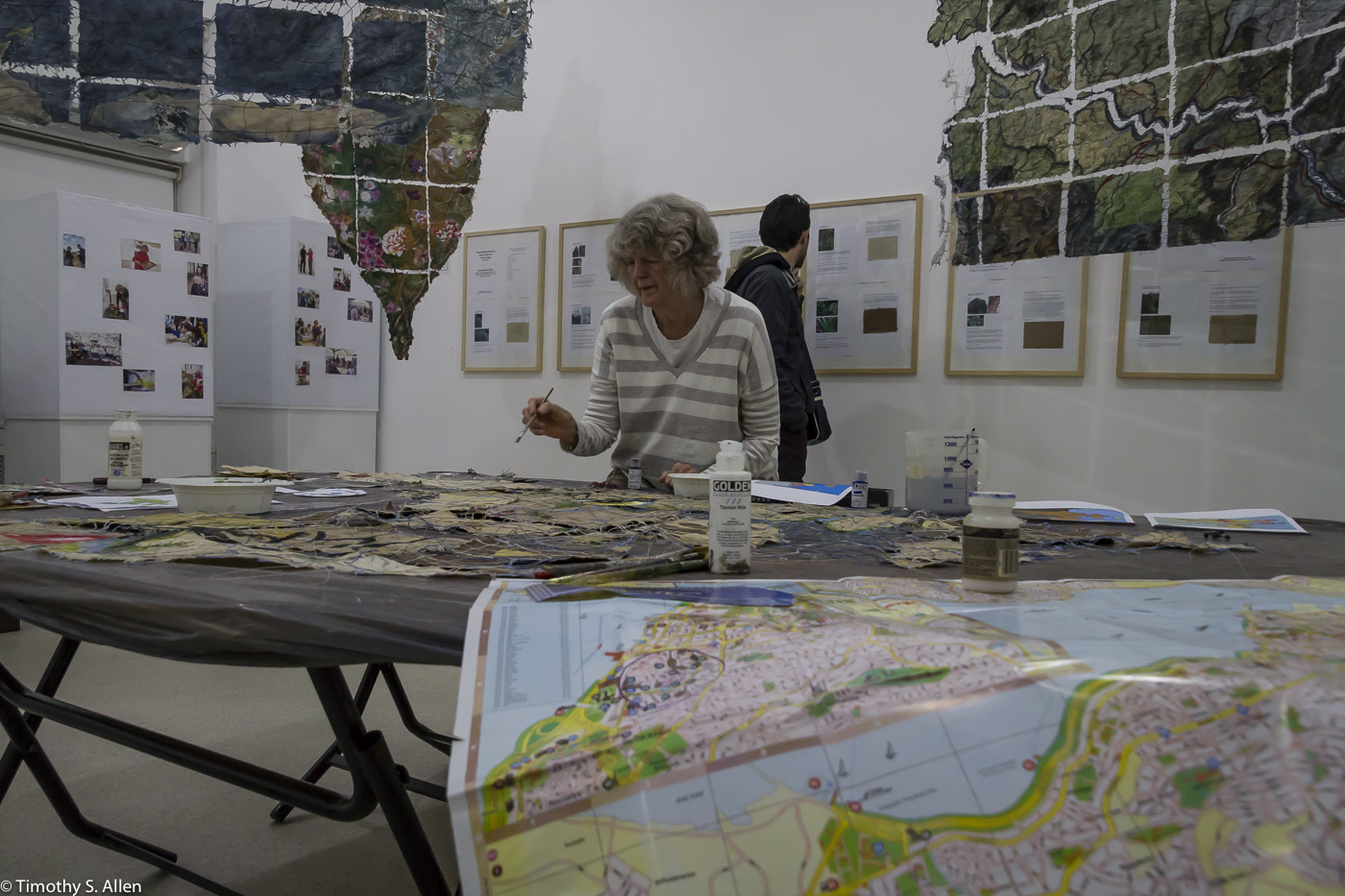
I hope that your 2016 is happy, healthy and adventurous!  This photo shows me working in Izmir, Turkey, on my recent Fulbright Specialist grant project with the Museum of Paper & Book Arts, Ege University, Izmir, Turkey.  My experience as an artist in residence in Turkey was great, and I am looking forward to more adventures in 2016.

PAINTING IZMIR MAP_MG_0386

I wanted to remind artists to send applications soon for the 2016 eco-art projects I curate in Taiwan. This Spring I will again be going back to Taiwan to curate two environmental art projects that invite international artists to come to Taiwan for a 25-day residency and create site-specific environmental art projects. Selected artists receive a stipend of US$2000, airfare, accommodations, meals and volunteer help.

The deadline for applications is coming up fast for the Cheng Long Wetlands International Environmental Art Project in Yunlin County, Taiwan. All application materials must be submitted by email to me at allenrebeccajanei@gmail.com by January 15, 2016. Selected artists will come to Cheng Long from April 7 to May 2, 2016, and the theme is “Meet the Future in Cheng Long”. For complete details about what to send to apply see the Blog at http://artproject4wetland.wordpress.comMarisa

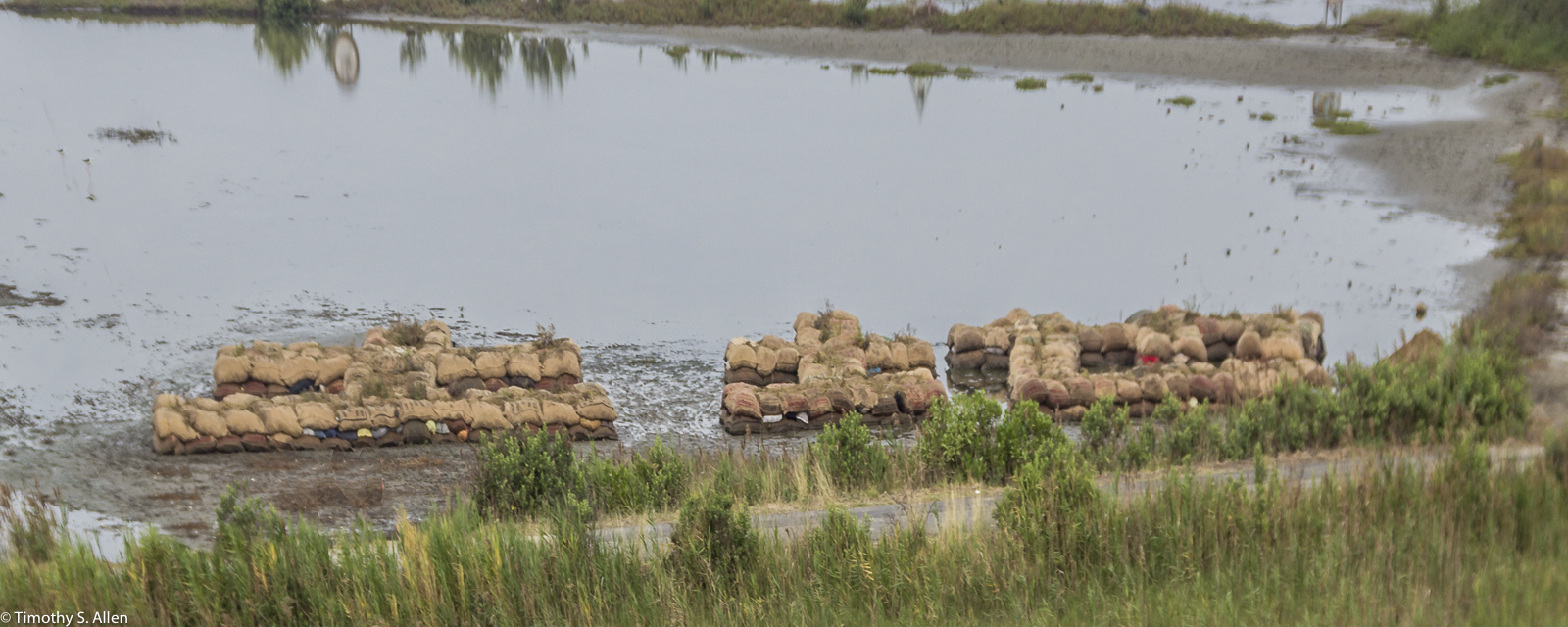
This photo shows Marisa Merlin’s 2015 installation in Cheng Long Wetlands.

I will also be curating the 2nd eco-art project in Keelung, Taiwan, with the National Museum of Marine Science & Technology. Look at the Museum’s website at http://www.nmmst.gov.tw Then click on to English and Activities and you will see the 2016 Call for Proposals. The theme for 2016 is “Envisioning the Future , and it is the 130th anniversary for Keelung port. Selected artists for the Keelung project will be in residency in Taiwan from May 12 to June 6, 2016.

outdoor installation by Taiwanese artist Chris Lee at the 2015 NMMST International Environmental Art Project in Keelung, Taiwan

outdoor installation by Taiwanese artist Chris Lee at the 2015 NMMST International Environmental Art Project in Keelung, Taiwan

The deadline for applications to the Cheng Long project is January 15 2016, and the deadline for applications to the Keelung art project is February 15, 2016. Hope to see your applications soon.

Like Loading...

Going to Turkey – Fulbright grant art project

23 Friday Oct 2015

Posted by janeingramallen in Uncategorized

≈ 12 Comments

Tags

artist-in-residency, Fulbright grant, handmade paper, installation, Izmir, Jane Ingram Allen, papermaking, timothy s. allen, Turkey

I am happy to announce that I have received a Fulbright Specialist Grant for an art project in Turkey at Ege University, Museum of Paper and Book Arts, Izmir, Turkey.
I will be flying to Turkey on November 18, 2015 and return to San Francisco on December 16, 2015. For the first week I will be in Istanbul touring some of the sites and seeing art museums and galleries on my own, and then going to Izmir on November 25 for the start of my Fulbright grant project.

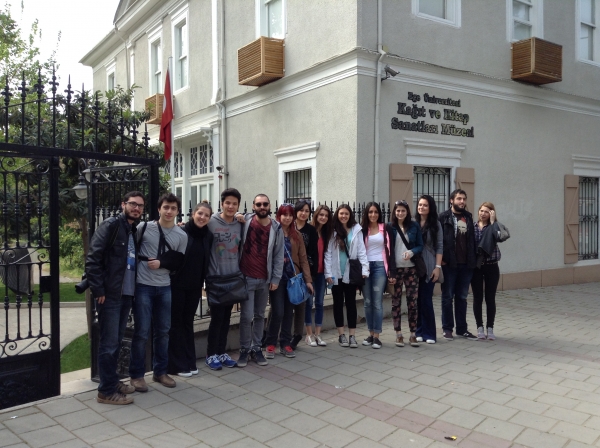
Here is a photo showing the outside of the Museum of Paper & Book Arts at Ege University, Izmir, Turkey, and a group of visiting students.

paper & book arts museum Izmir

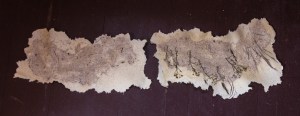
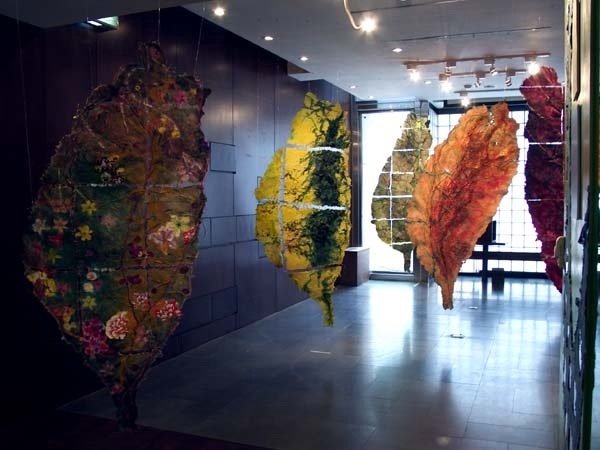
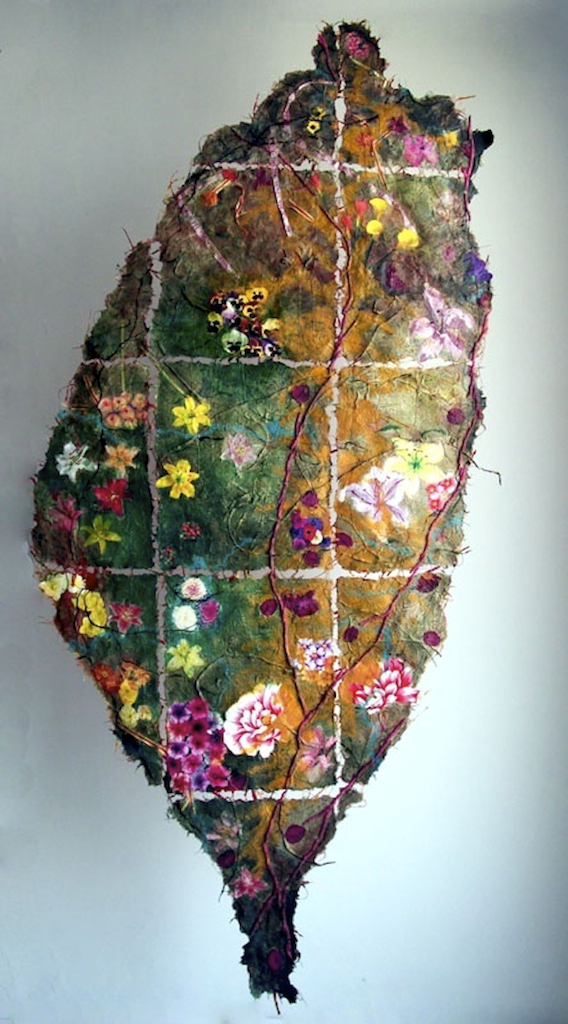
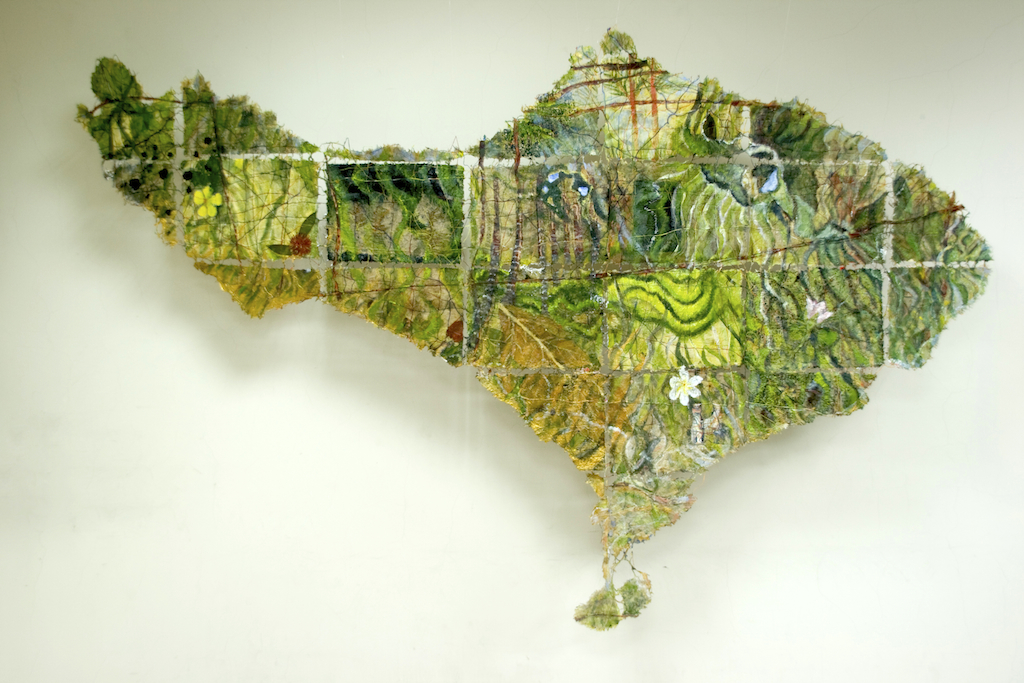
During the 20-day Fulbright Specialist grant in Izmir, I will be exploring the plants around Izmir to use for my papermaking art and creating some new artworks using local materials and inspired by the place. I will also teach papermaking workshops at the Ege Univerisity Musuem of Paper and Book Arts and consult with the Museum and the university about curriculum in paper arts and environmental art.  I will also help them to set up a papermaking studio or workshop at the Museum.  I will also have an exhibition of my handmade paper artworks at EgeArt 2015, an international art festival held in Izmir from Dec. 11-13, 2015.  My exhibition will include some of the handmade paper “site maps” I have created in other residencies around the world, including during my 2004 and 2005 Fulbright grant projects in Taiwan and a 2010 artist in residency project in Bali, Indonesia.  Here are some photos of a Taiwan Site Map and a Bali Site Map.

Taiwan site map floral abundance Bali site map front 1

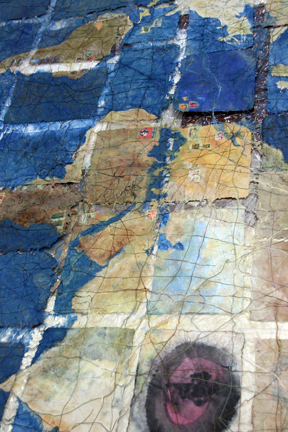
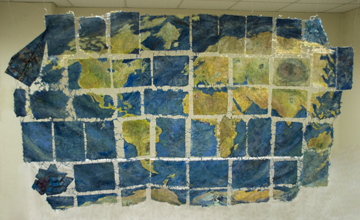
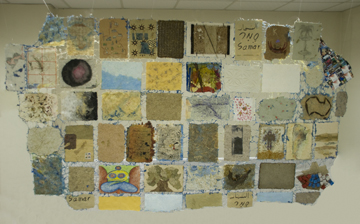
I know the Paper & Book Arts Museum in Turkey through my international art project “One World Many Papers” that was a collaborative paper artwork I created with artists from around the world.  I asked the participating artists to send me a sheet of paper they made to represent their country and then I joined all the sheets of paper together to make a large map of the world having no political borders.  The finished piece was donated to the Paper & Book Arts Museum in Turkey at Ege Univeristy, Izmir, in 2011, shortly after the museum opened.  Before getting its permanent home in Turkey, this artwork was seen in exhibitions around the world in 2009 and 2010.  Here is a photo of the finished artwork.  For more information about my “One World – Many papers Project” please visit my other Blog: http://www.janeingramallenart.blogspot.com

world-side-small map-side-email artistside-email

I will be posting on this WordPress Blog more about the work I do in Izmir.  Please check back later in November for photos of the places I see and the artwork I make during this art project in Turkey. My husband Timothy S. Allen is going with me to Turkey, and he will be taking lots of photos to document my work and also photos of our experiences in Turkey. His Blog is at http://allentimphotos2.wordpress.com

Like Loading...

More about Jane Ingram Allen’s Artist in Residency at Fire Island National Seashore

21 Monday Sep 2015

Posted by janeingramallen in Uncategorized

≈ 4 Comments

Tags

artist-in-residency, Fire Island National Seashore, handmade paper, papermaking, plants for papermaking

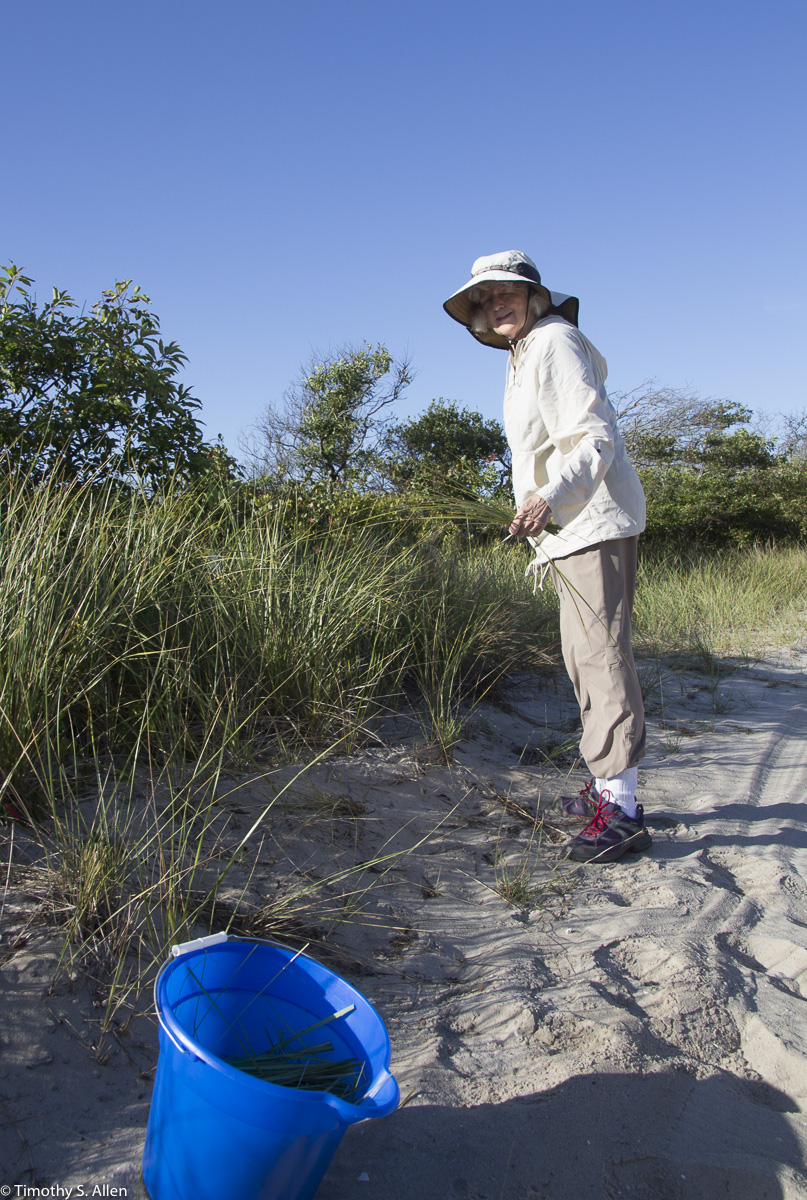
During my two-week artist in residency at Fire Island National Seashore from Sept. 5 to Sept. 19, 2015, I lived and worked at Watch Hill near the Watch Hill Ferry Station in Staff House #8. My husband Timothy S. Allen was able to join me for the residency, and Tim took many photographs of my process and the work I did at Fire Island. This was my first time to visit Fire Island, and I was inspired by the beauty of the place and its unique ecology. What impressed me most is that it is a natural area and a wilderness yet so close to New York City. This is one of most heavily populated regions in the world, yet Fire Island National Seashore offers a great nature experience with no cars, no restaurants, few stores and not so many people. It has an abundance of wildlife including many different plants…also many mosquitoes and deer ticks and lots of poison ivy that make gathering plant materials challenging!
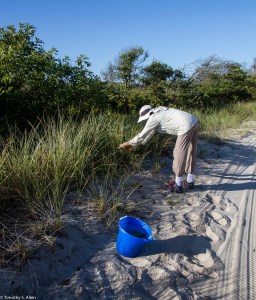
Jane picking sea grass

At Watch Hill there are usually only a few campers and boaters and day trippers who come over on the ferry from Patchogue during the weekends. My residency on Fire Island started on Saturday of Labor Day weekend, and it was very crowded and bustling with many boats, campers, and those who came for the holiday to enjoy the beautiful beach and the great sunny weather. After Labor Day things definitely were different and much quieter. There is ferry service to Fire Island Watch Hill Station on weekends until October, and the snack shop and store is open also on weekends. We brought all of our food and personal needs with us on the ferry when we came over from Patchogue, Long Island. I also had to bring everything I would need to do my artwork in the suitcase with me from California.
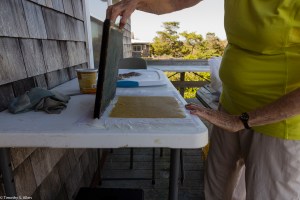
jane making paper at Fire Island


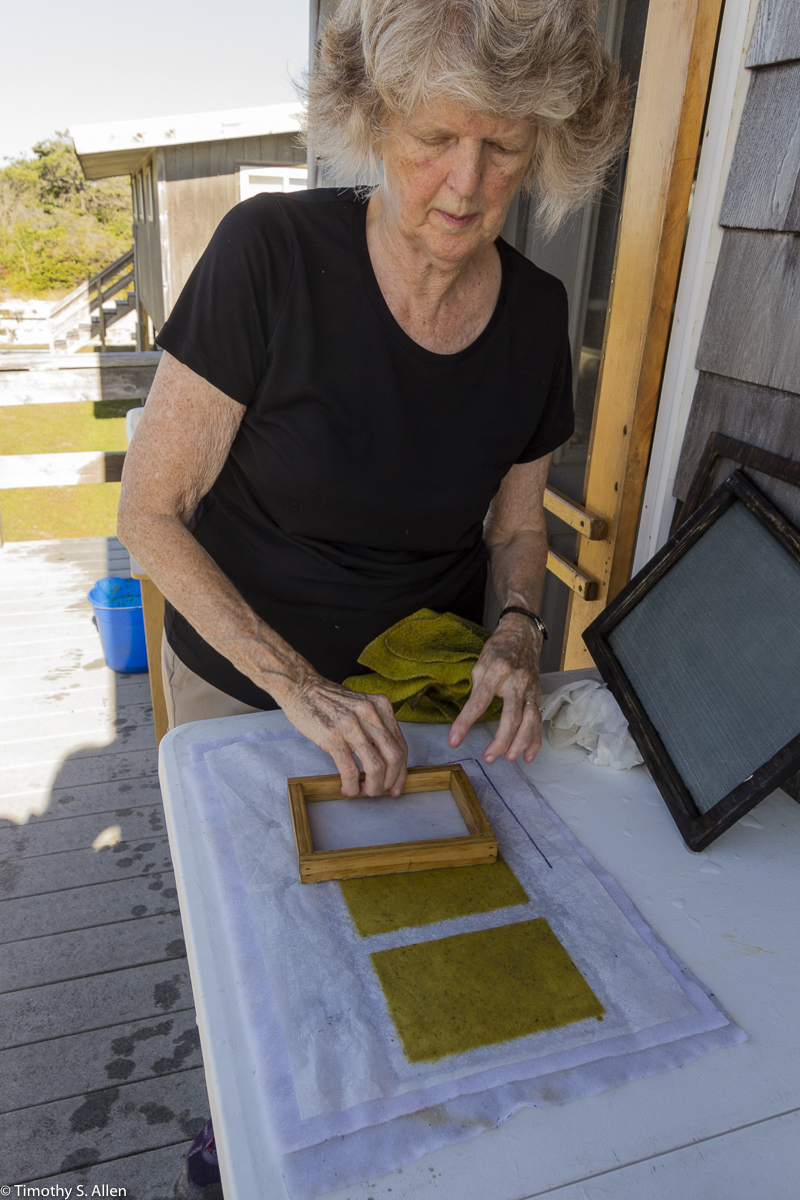
Fortunately I have an artist friend, Marcia Widenor, who lives in Sea Cliff on Long Island, and she helped me get together the things I would need for the residency. She let us borrow some sheets and towels and also buckets, plastic bins and stainless steel cooking pots. I brought all the other necessary items for hand papermaking in my suitcase. I am used to setting up a papermaking studio with minimal equipment and supplies and using what I find on site. I did bring in my suitcase a blender and a wooden hammer and some powdered formation aid, a few moulds and deckles, felts and non-woven interfacing as well as some miscellaneous art materials.
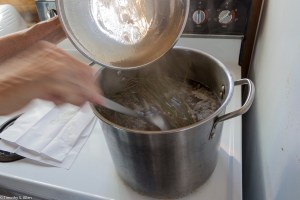
Cooking sea grass


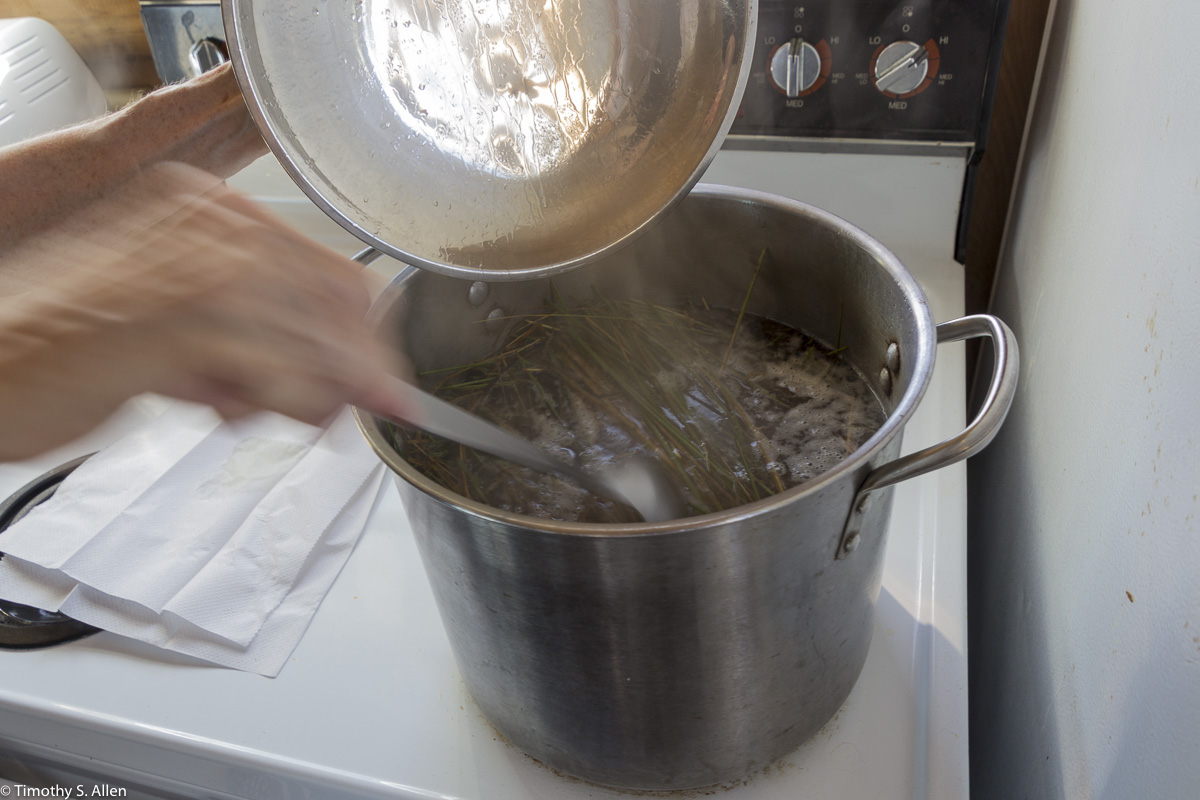
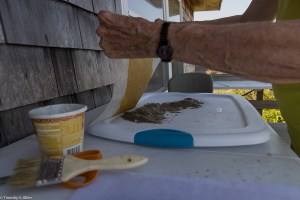
My plan for Fire Island was to make handmade paper for my artwork from the local plant waste materials, harvesting leaves and bark in a sustainable way so as not to harm any living plants. I used four plants that I collected and prepared on Fire Island. The vegetation for papermaking at Watch Hill is very limited, and I could find no trees that I could get the bark from to make paper.  I did find many long leafed beach and marsh plants and was able to use the leaf plant fibers. The most abundant plant is Phragmites australis, or common reed, that is considered invasive.   For my handmade paper, I used Phragmites, beach grass, Iris leaves and eel grass (seaweed). In this book I have outlined the recipes for making paper from each of these plants and included a sample of the handmade paper for that plant.
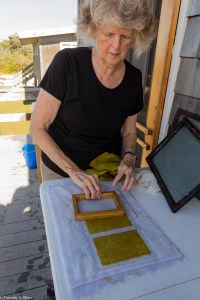
Jane making Phragmites paper samples.


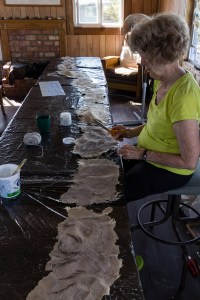
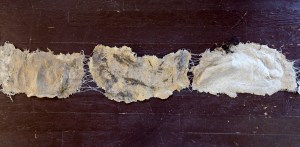
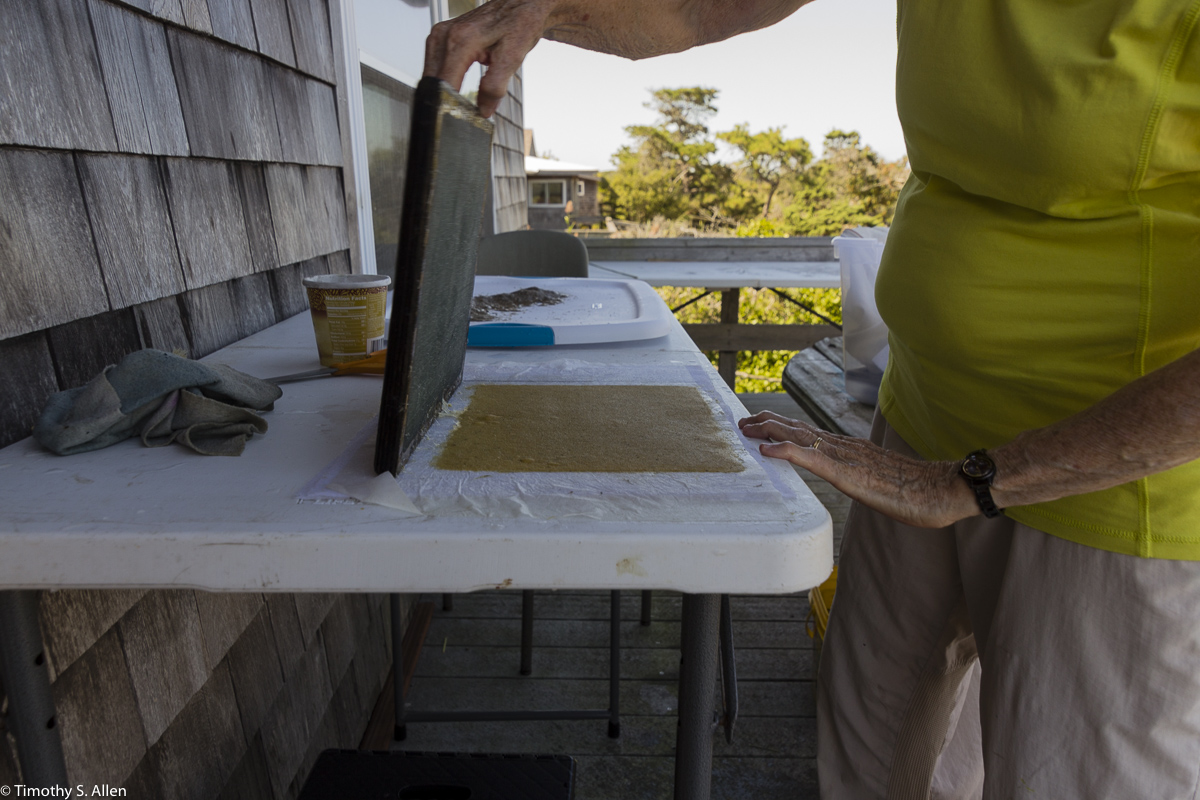
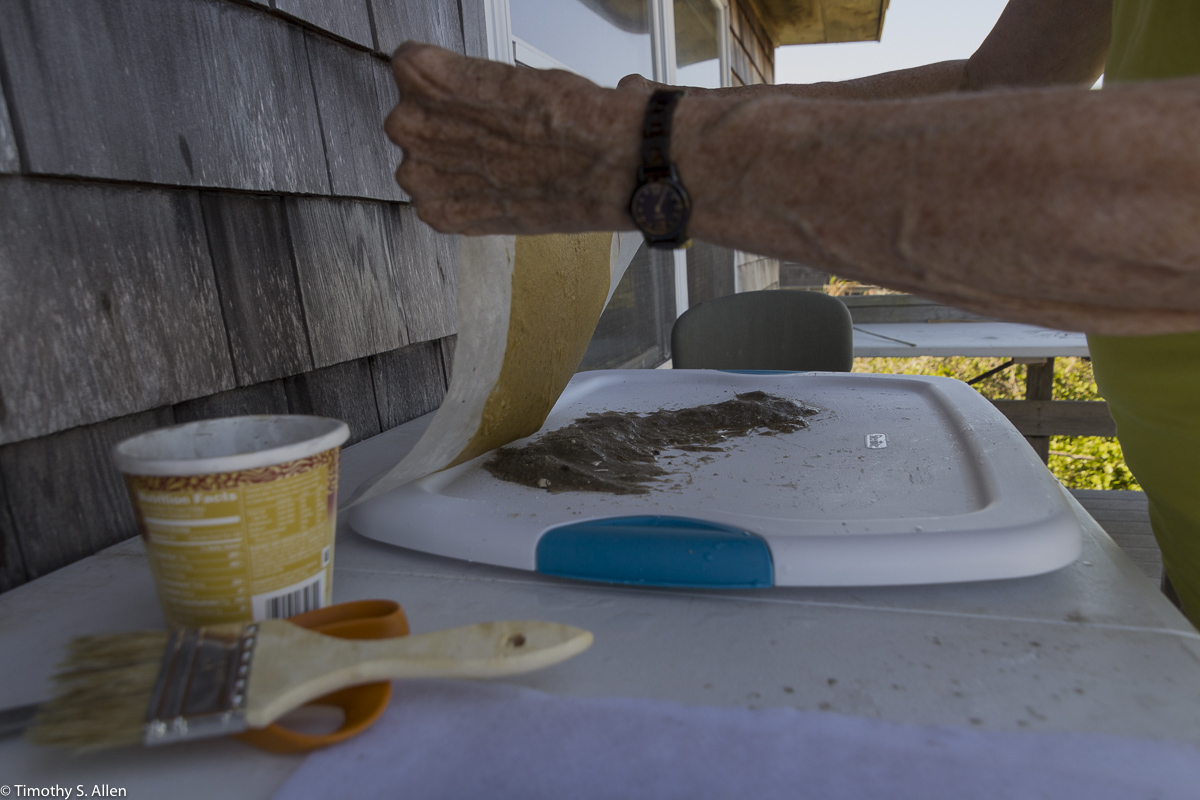
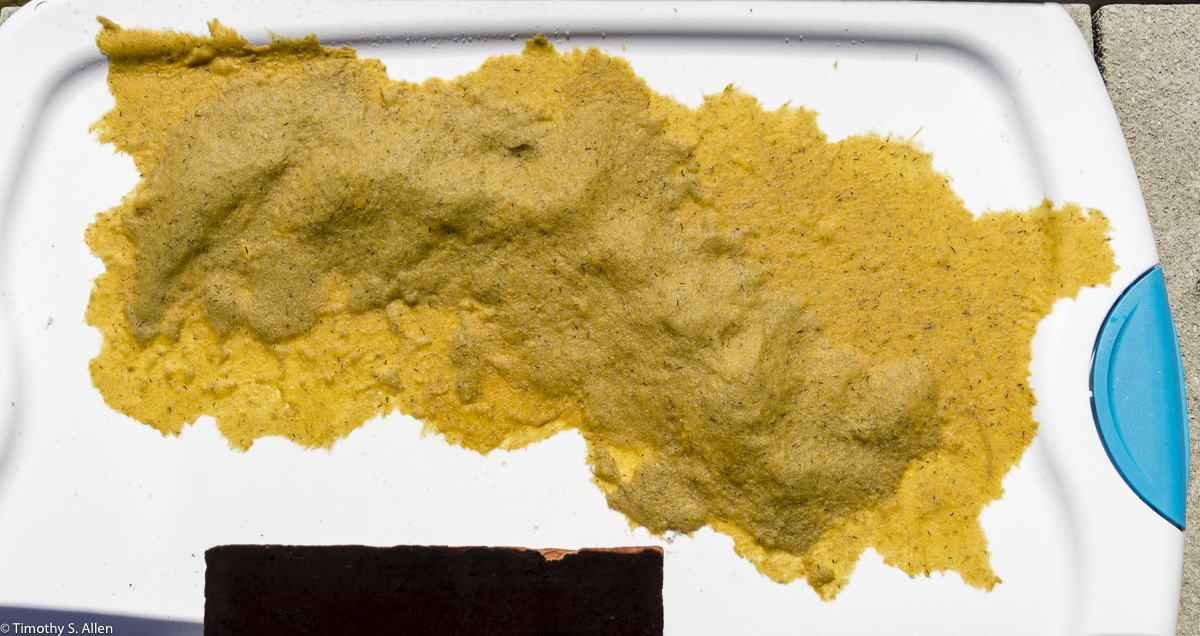
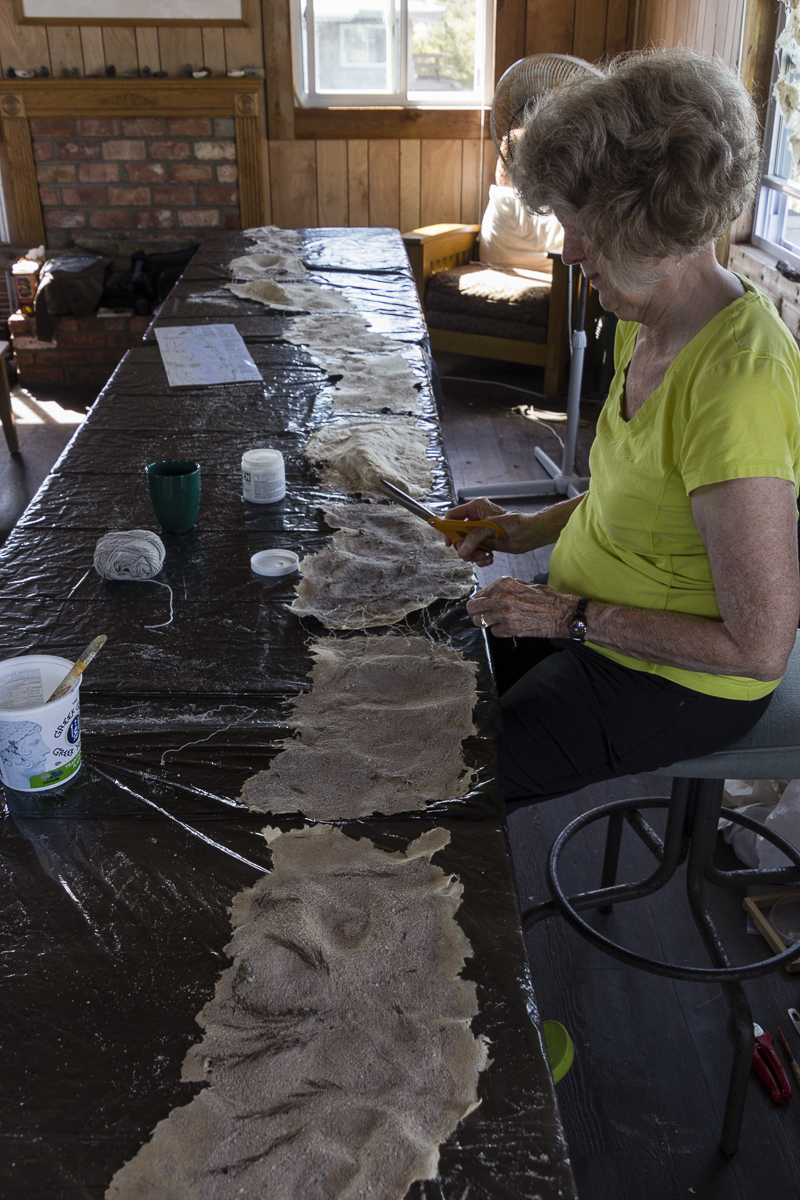
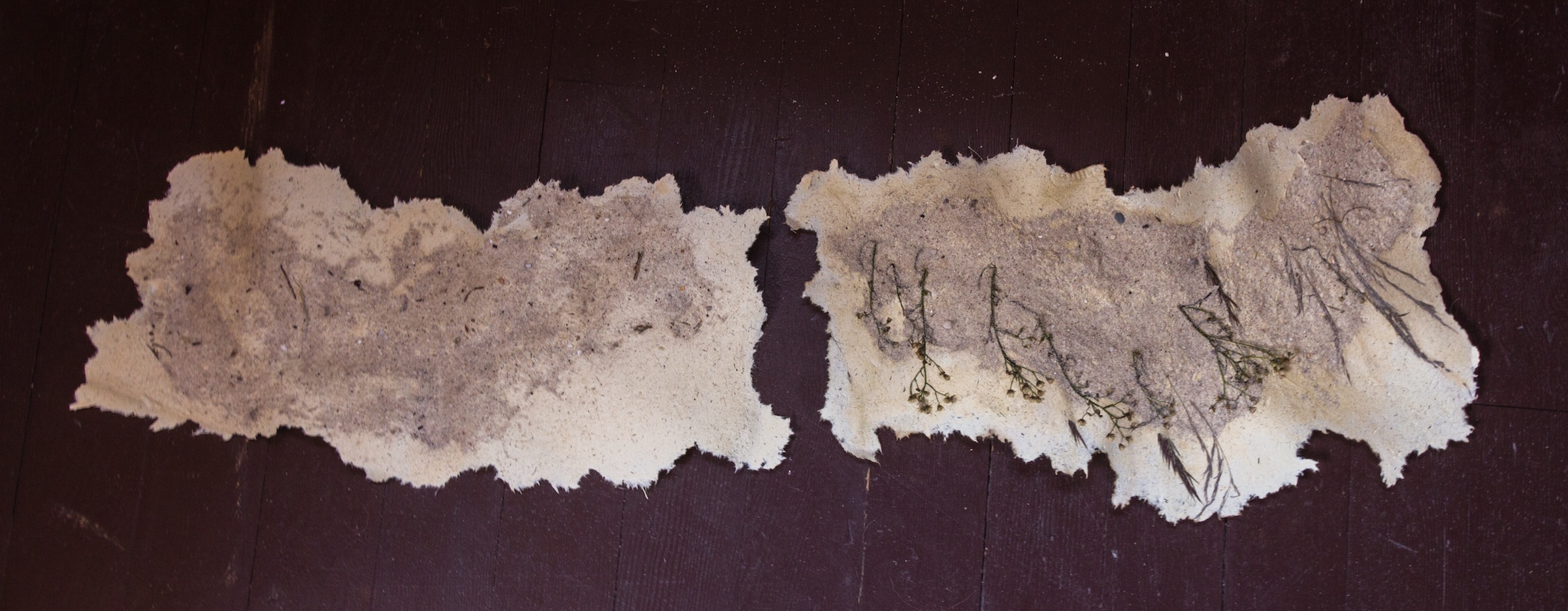
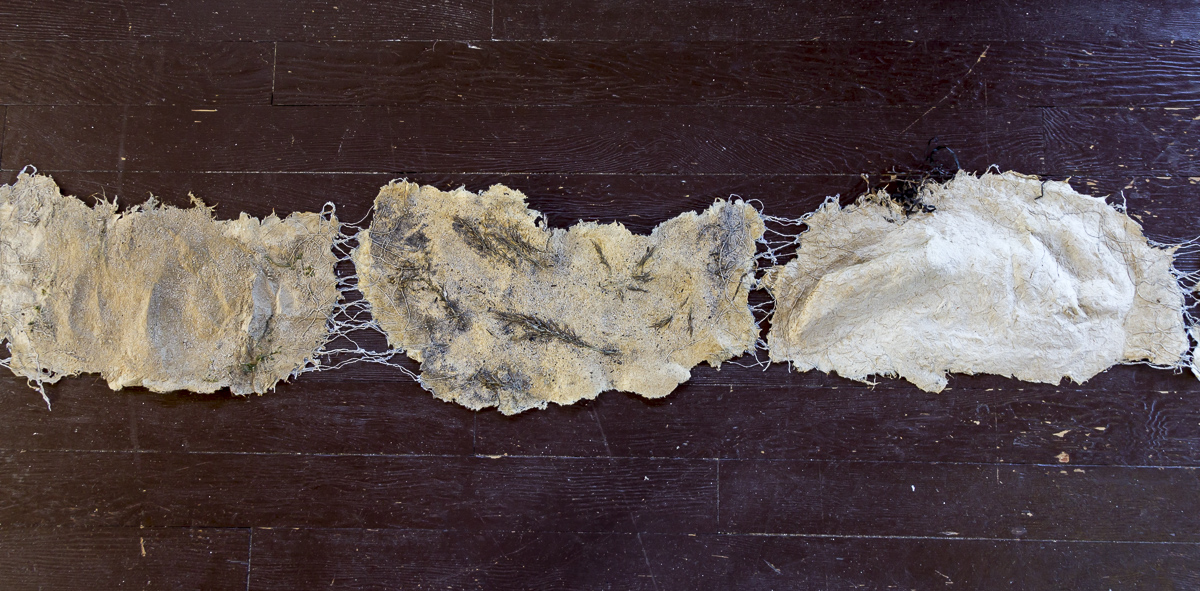
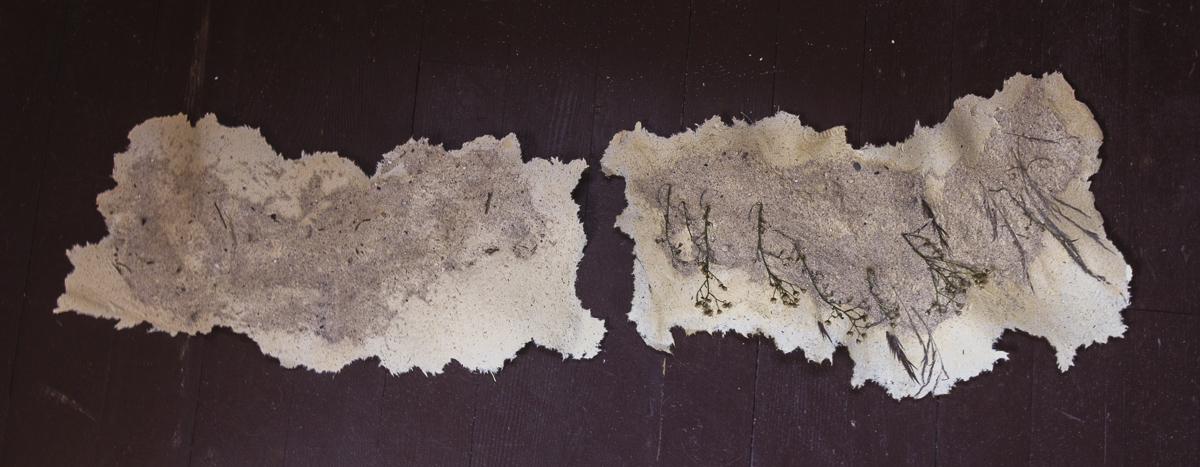
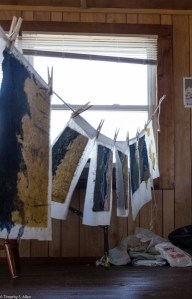
For one artwork I made on Fire Island I decided to try sand casting with handmade paper, placing sheets of the wet handmade paper created with local plants on the sand to dry. The beach at Fire Island National Seashore has beautiful almost white sand. I was also influenced by reading about the effects of Hurricane Sandy on Fire Island and how the shape of the island is constantly changing with shifting sands and changing ocean conditions.   For the sand cast handmade paper, I made the sand wet and sculpted it to form dunes and added bits of the local plants in the sand. Then I placed my handmade paper on the shaped sand to dry. When the paper was dry I removed the handmade paper and dusted off the loose sand. Then I reshaped the sand for the next piece. Each sand casting was about 18 inches long and 12 inches high. For creating a Fire Island Site Map, I joined the pieces in a long curving shape with natural thread and used acrylic matte gel as glue. The total piece is about 18 feet long and 12 inches high and has a variable thickness from 1 inch to 4 inches. I plan to suspend this work from the ceiling near a long wall for an installation. It can also curve around a corner or hang out in space. It folds up at the thread for easy transport and storage, so I am able to bring it with me for later exhibitions.
_MG_32382_MG_32393_MG_32404_MG_32425_MG_32447_MG_32461Jane working on site mapsand dunes 2 piecessite map detail


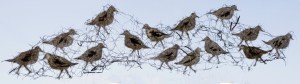
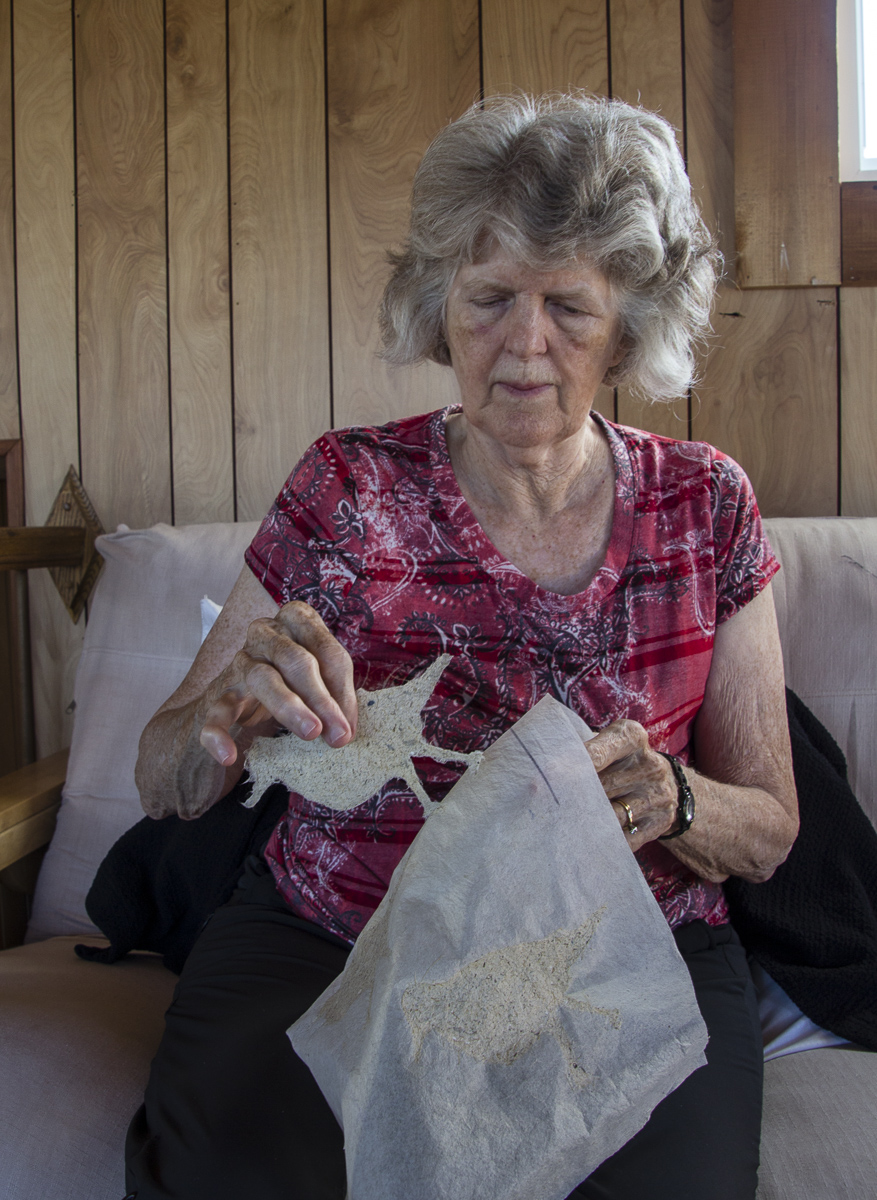
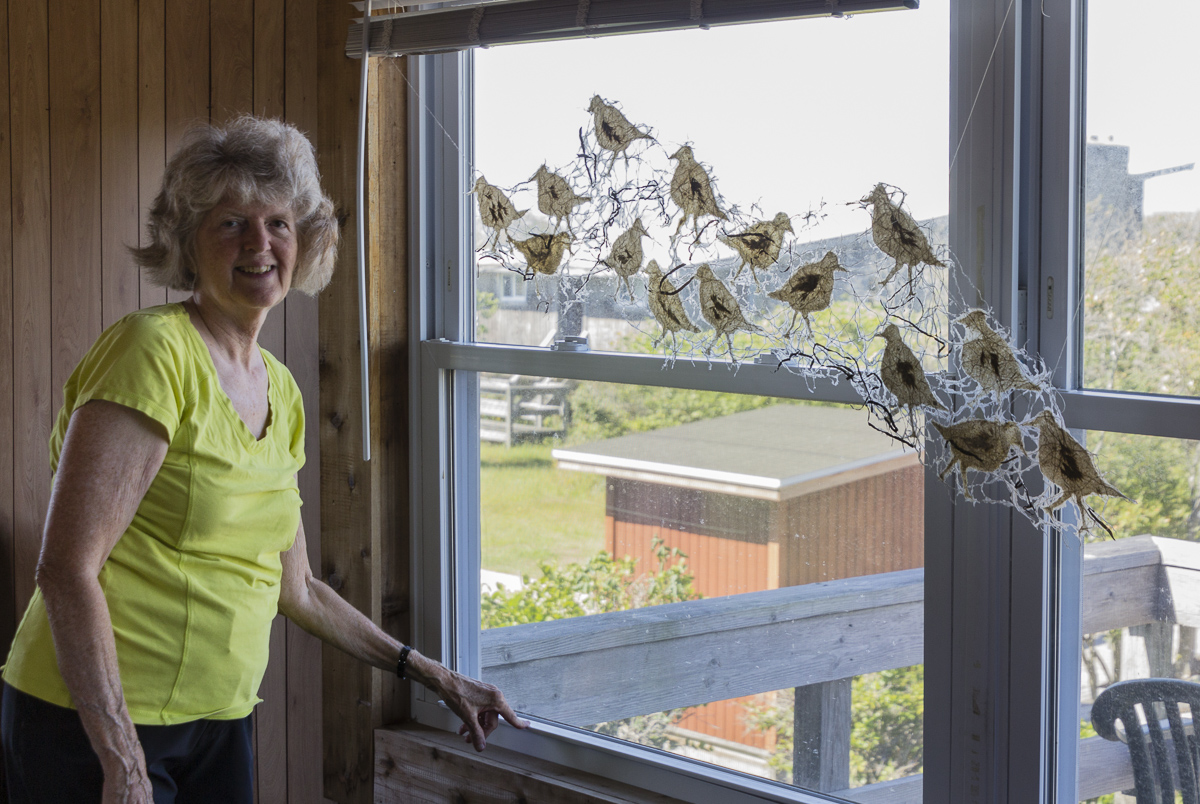
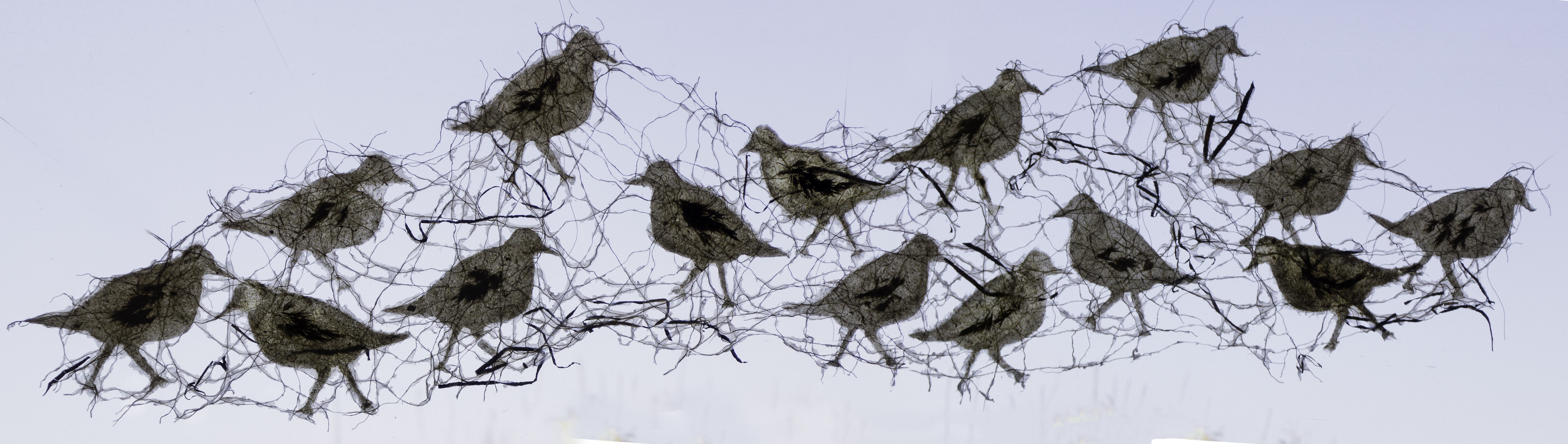
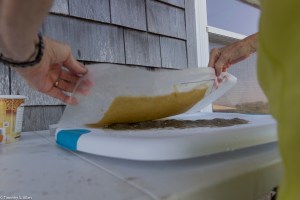
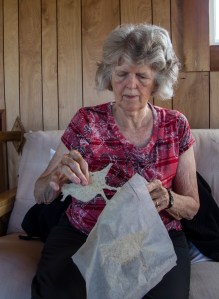
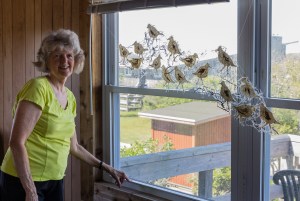
The many birds I encountered on the beach at Fire Island National Seashore inspired another artwork I created during the residency. I learned that the piping plover, an endangered species, nests near Watch Hill. I made a stencil in the shape of the piping plover with buttercut material on one of the small moulds I brought. I saw many plovers on the beach at Watch Hill, and one day a small flock of piping plovers came swooping in to feed near the water line as I was walking along the beach. These small birds really do make “piping” noises. I created two suspended “piping plover” artworks (one piece has 15 plovers in the flock and the other has 9 plovers). The handmade paper plover shapes are joined together with natural threads and I used Phragmites plumes, feathers collected on the beach and some seaweed (eel grass) to add details in the handmade paper birds. These artworks will hang in front of windows or from the ceiling with light coming through the thin Asian-style handmade paper.
 

Jane peeling birds off

Jane standing in front of hanging birds plovers pano


I also created other pieces of handmade paper from local plants during the time at Fire Island, and I plan to continue working with them when I am back at my home in Santa Rosa, California. This residency was a great experience for me, and I enjoyed very much the time to experiment and work with new and different plant fibers. It was also a great chance to be inspired by a beautiful national park area and a wilderness so close to New York City.  I would like to thank the Fire Island National Seashore staff for all of their help, especially Interpretive Specialist/Park Ranger Kristin Santos and coordinator of the Fire Island National Seashore Artist-in-Residency program, Dawn Lee.
_MG_40571

The photos of the plants and of my process were taken by my husband Timothy S. Allen. You can see more photos of my previous residencies and other artworks at my website:  http://www.janeingramallen.com

Tim’s photo blog at http://allentimphotos2.wordpress.com also has other photos from our time at Fire Island National Seashore.
Like Loading...

Jane Ingram Allen’s Fire Island National Seashore Artist in Residency Public Program, Sat., Sept. 12. 2015

09 Wednesday Sep 2015

Posted by janeingramallen in Uncategorized

≈ Leave a comment

Tags

artist-in-residency, Fire Island, Fire Island National Seashore, local plants, Long Island, papermaking, Watch Hill Visitor Center

Hello everyone,

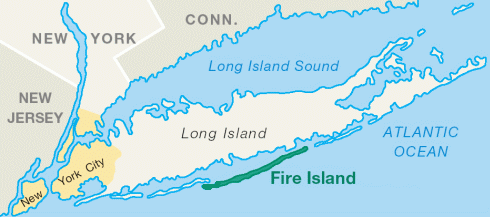
You are all invited to come visit me at Fire Island National Seashore this Saturday, Sept. 19, 11AM to 4 PM for a Papermaking Demonstration and public activities.Fire_Island-NY-USA-Location_Map-01

The program is free and open to all. To get here, take the ferry (www.davisparkferry.com) from Patchogue, NY to Watch Hill on Fire Island.  At the Watch Hill Ferry station and the Watch Hill Visitor Center, ask for directions to the Watch Hill Dune Station where you can see my papermaking art going on Saturday from 11 – 4 PM.

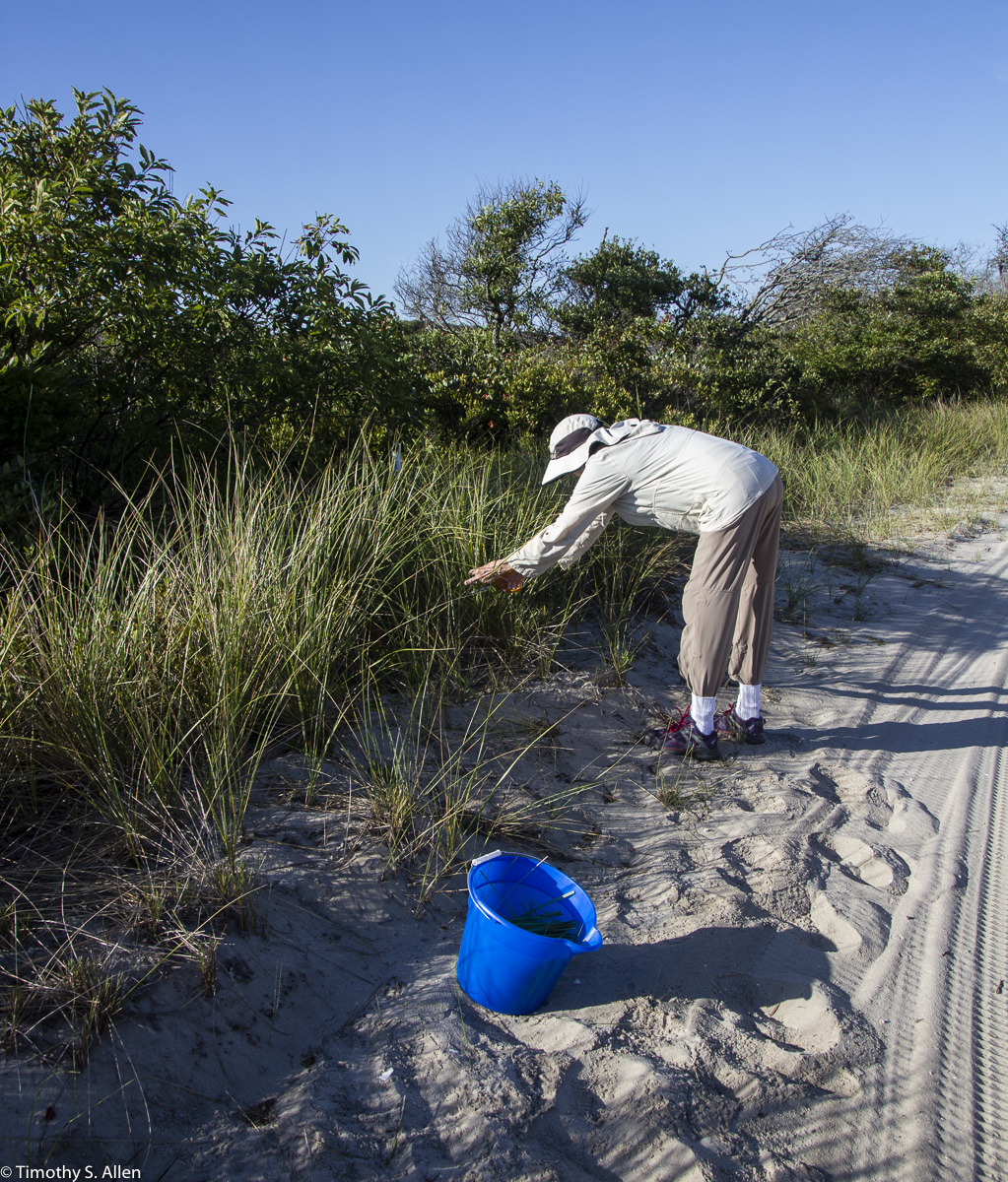
I am an artist in residence at Fire Island National Seashore from Sept. 15 – 19, and I am creating new artworks inspired by this beautiful place using local natural materials to make handmade paper. I have already made some paper for my work from local beach grass and Phragmites, and today I am trying some seaweed collected on the beach.

Jane and blue bucket

Hope to see you at the public program on Saturday, Sept. 12, 11AM to 4PM at the Watch Hill Dune Station, Watch Hill Visitor Center, Fire Island, NY. If you want to come visit on any other days before Sept. 19, you are also welcome.  Please contact me by email at info@janeingramallen.com

This photo is some pieces of handmade paper created with sand casting…the pulp is from beach grass and sand of course collected on the beach at Watch Hill.

sand dune paper

Keep checking this Blog for more photos of the residency at Fire Island National Seashore.  Photos are by my husband Timothy S. Allen, who is enjoying Fire Island with me at this residency.

Like Loading...

Artist in Residency at Fire Island National Seashore, NY

24 Monday Aug 2015

Posted by janeingramallen in Uncategorized

≈ 2 Comments

Tags

artist-in-residency, Fire Island National Seashore, Long Island, papermaking, plants for papermaking

Fire_Island-NY-USA-Location_Map-01

From Sept. 5 – Sept. 19, 2015, I will be an artist in residence at Fire Island National Seashore http://www.nps.gov/fiis/index.htm
Fire Island is a long barrier island off the southern coast of Long Island, and this year celebrating its 50th year as a national park. During my two weeks on Fire Island I will be exploring the plant waste materials and creating new mixed media handmade paper artworks. Keep watching here for photos of my Fire Island residency.

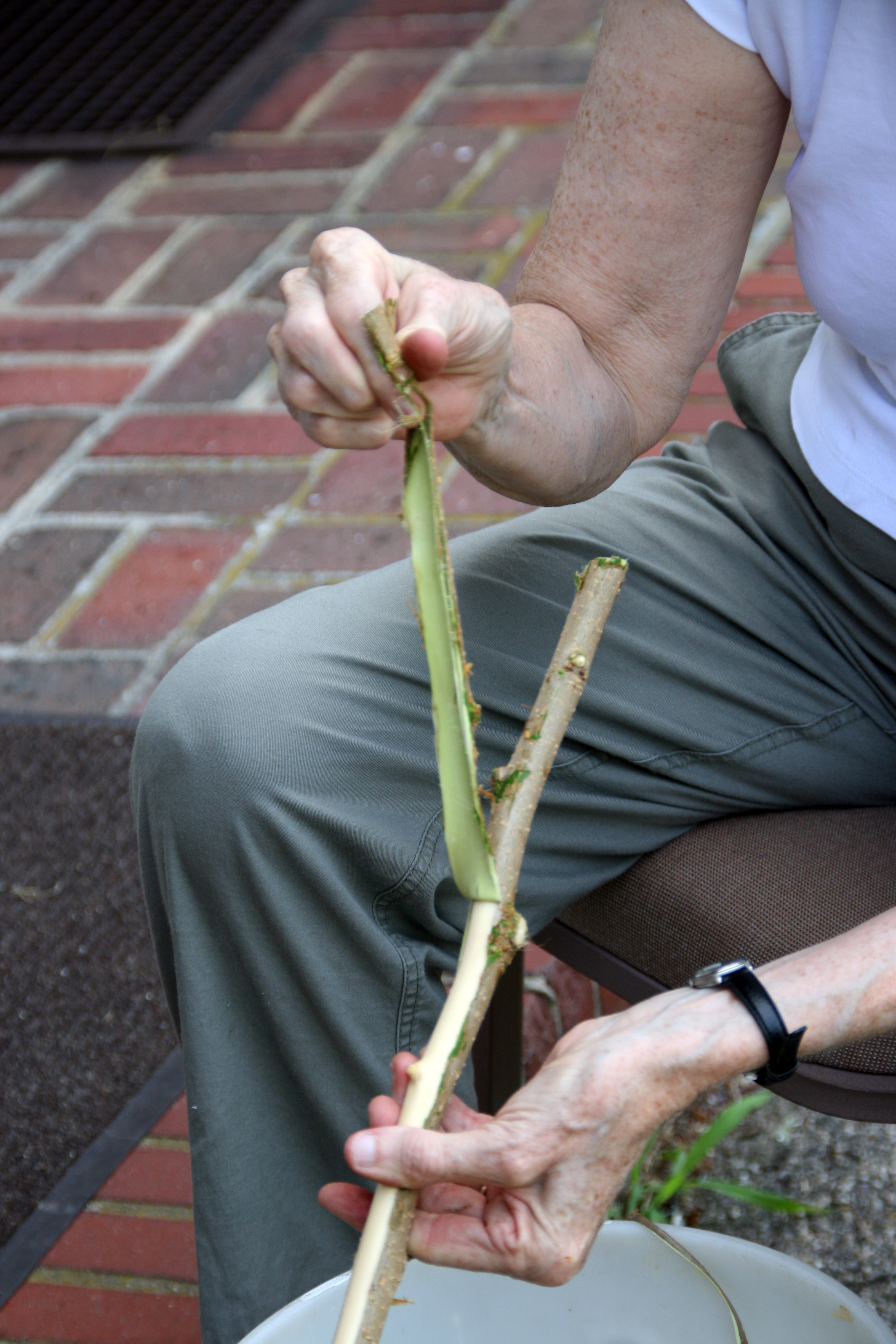
peeling-mulberry-bark-large

Like Loading...

Artist in Residency Project at Nan Hua University, Chiayi County, Taiwan: March 16-29, 2014

31 Monday Mar 2014

Posted by janeingramallen in Uncategorized

≈ Leave a comment

Tags

Architecture and Landscape Design Department, artist-in-residency, Chaiyi County, handmade paper, Jane Ingram Allen, Nan Hua University, Studio, Taiwan


Image

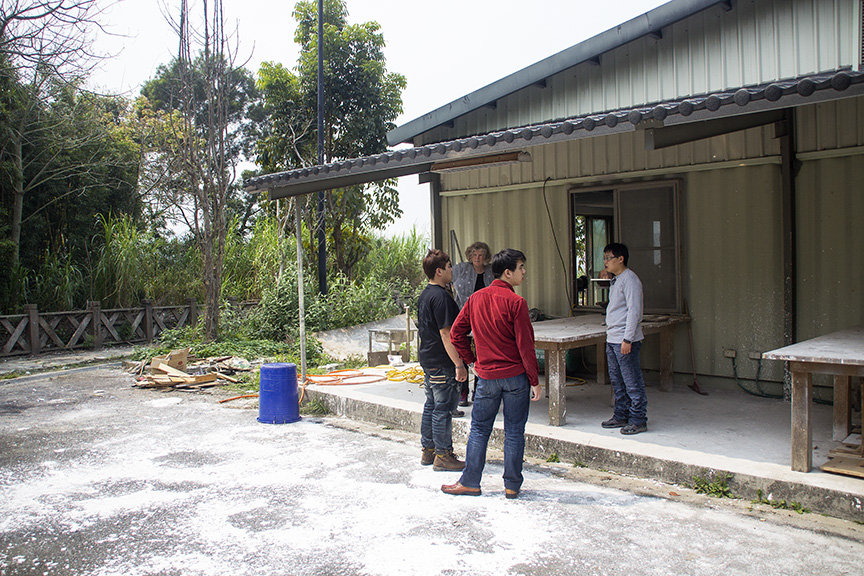
This photo shows me looking over the outdoor studio space on the first day of my residency at Nan Hua University.  This is where I will set up a hand papermaking studio and work with the students in Architecture and Landscape Design to make a collaborative multi-part installation of handmade paper using all natural and bio-degradable materials.

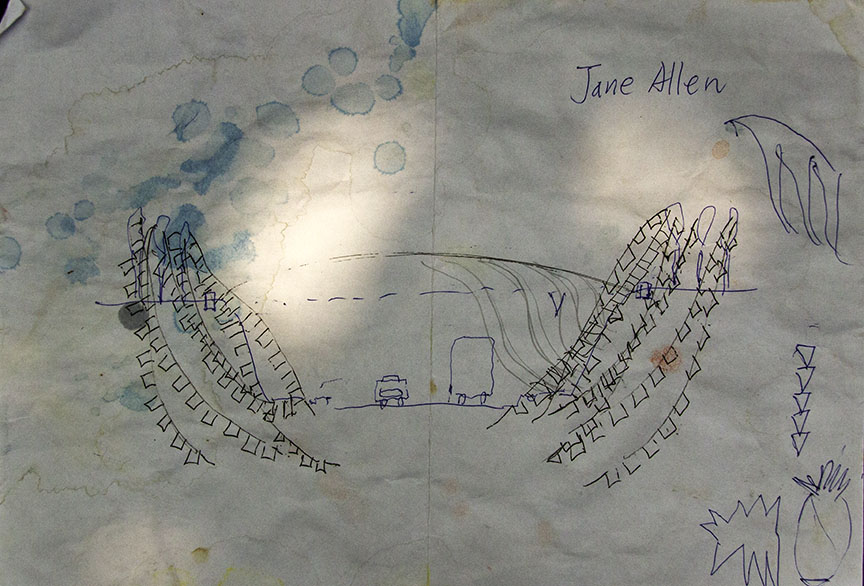
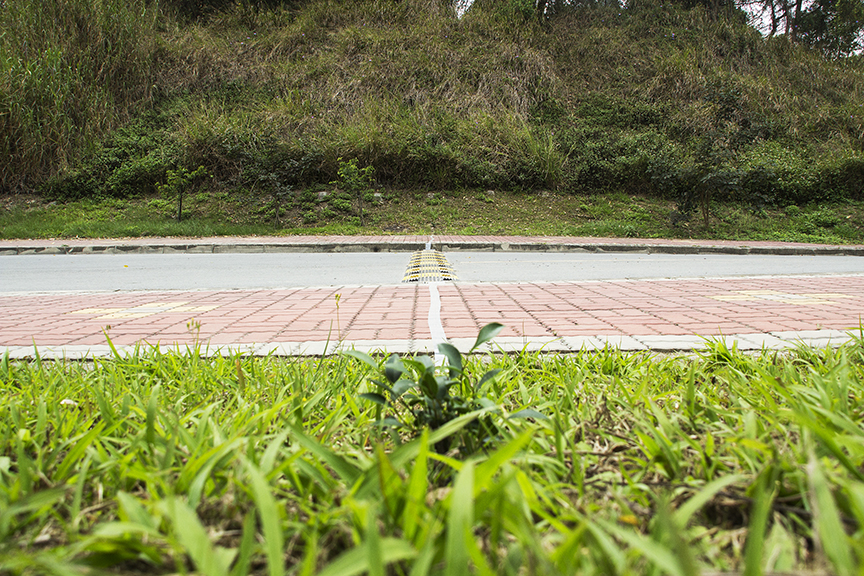
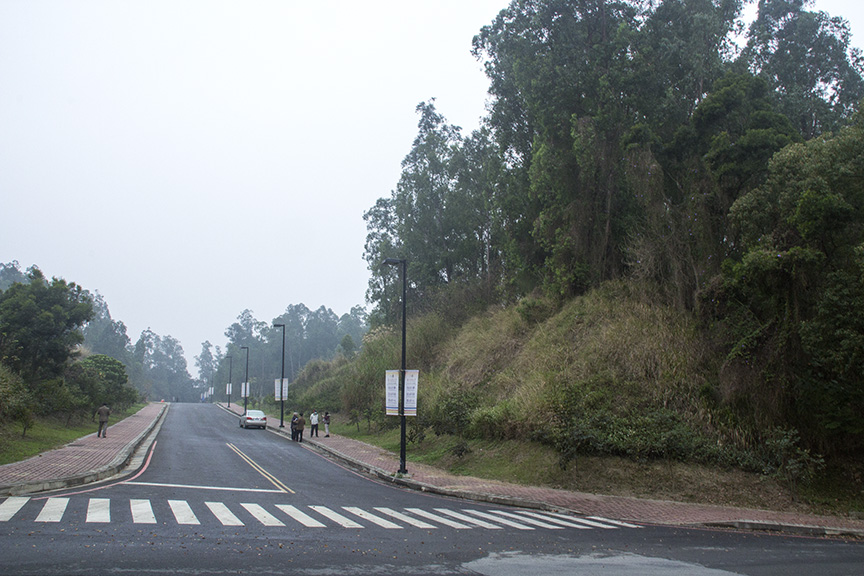
The idea for this art installation came after visiting the campus and talking about the environmental problems in the area, and we decided to try to make an art installation that would symbolically help to heal the land that had been damaged when the university was first built and a road was cut into the hillside destroying the beautiful curve of a ridge.

Image After studying the site, I thought of using colorful handmade paper prayer flags suspended from the trees on either side of this cut.  This is my first sketch of the art installation, showing that the artwork could be made in many unique parts and involve the students to teach them about papermaking and introduce the idea of creating art with natural, biodegradable materials that could be good for the environment and go back to nature after lasting for a while.Image

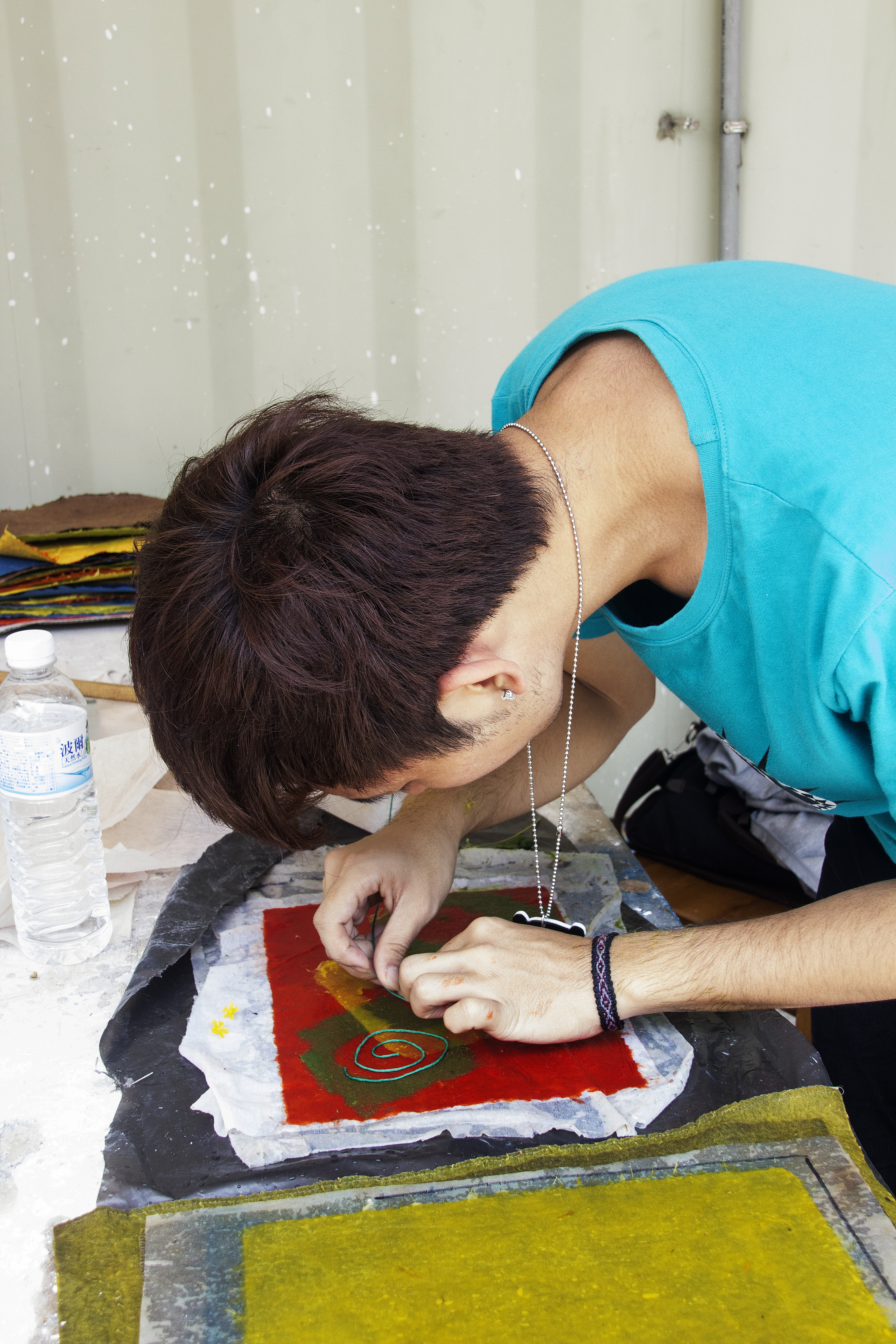
This photo shows a handmade paper prayer flag in red being made by a student at Nan Hua University.

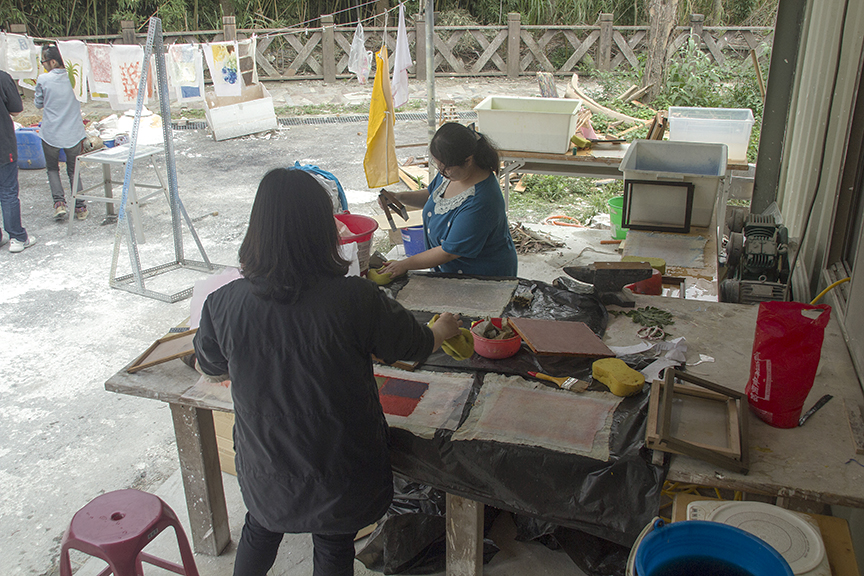
ImageHere you can see several students making handmade paper prayer flags for the installation.  Image

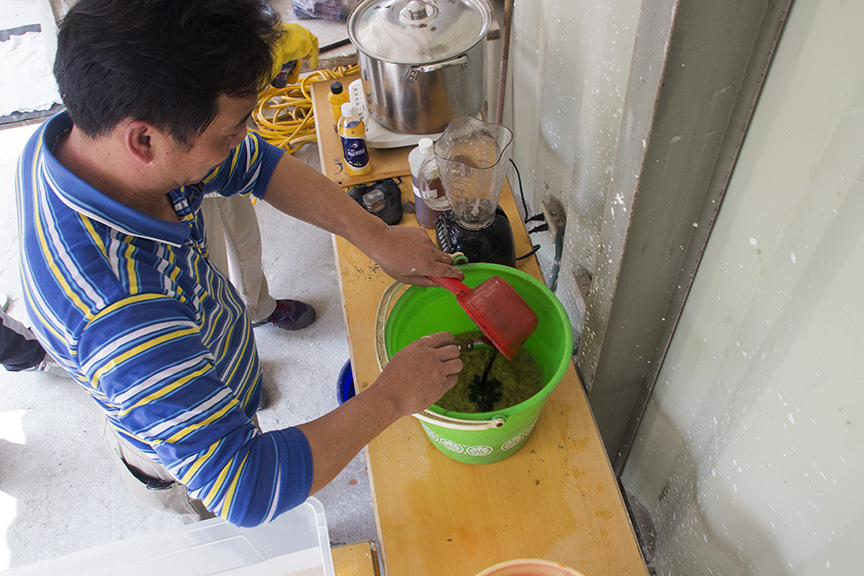
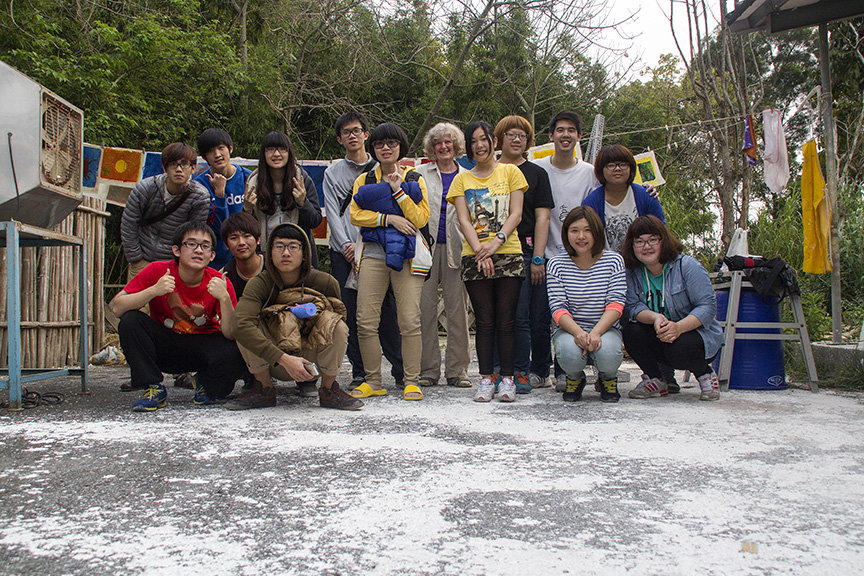
In this photo you can see a student helping to color the paper pulp with yellow non-toxic fiber reactive dye.  ImageThis photos shows a group of students posing with me in fron of the lines of handmade paper prayers flags they created drying in the sun.  We used 4 local plant waste materials to make some of the paper for the prayer flags, and also bought some prepared pulp from the paper factory in Puli (Nantou County) Taiwan to use for the prayer flags. We dyed the paper pulp with liquid fiber reactive dye that is non-toxic and does not harm the earth.Image

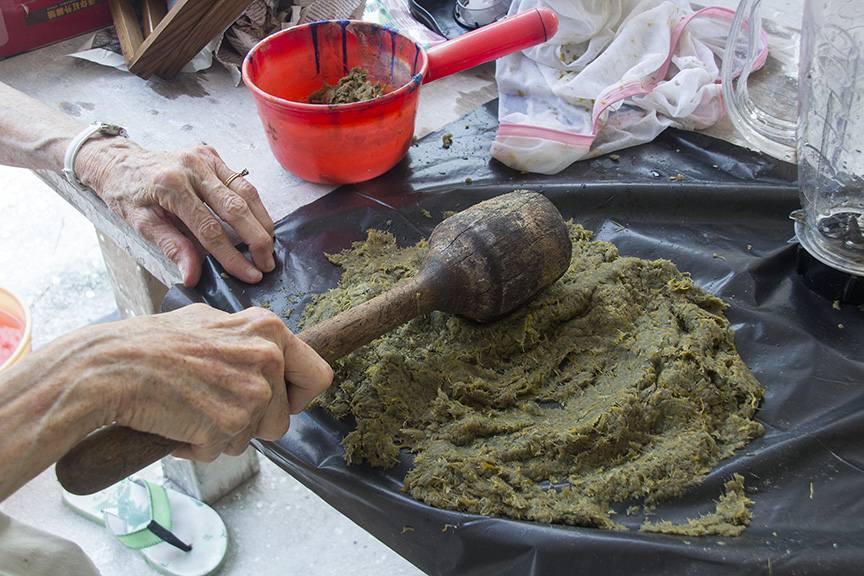
This photo shows me beating some local sugar cane plant fibers to make pulp for some of the prayer flags at Nan Hua University.


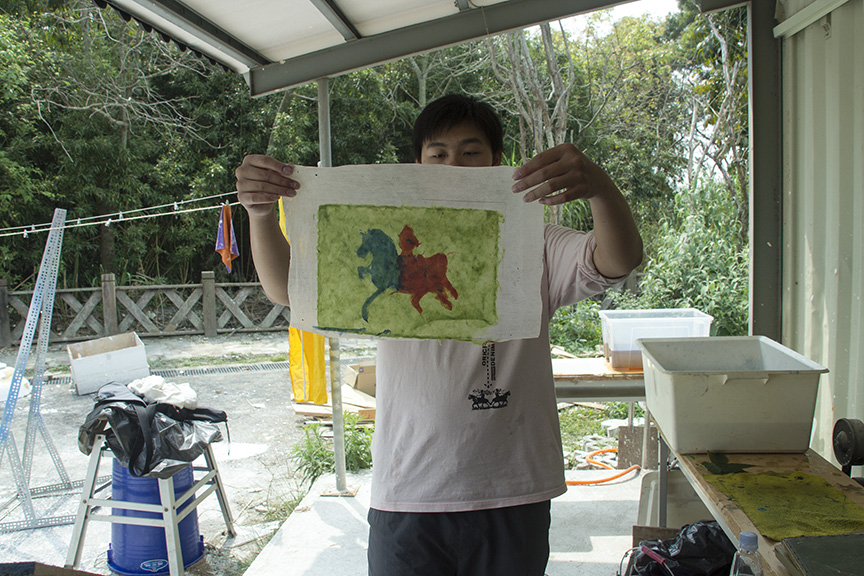
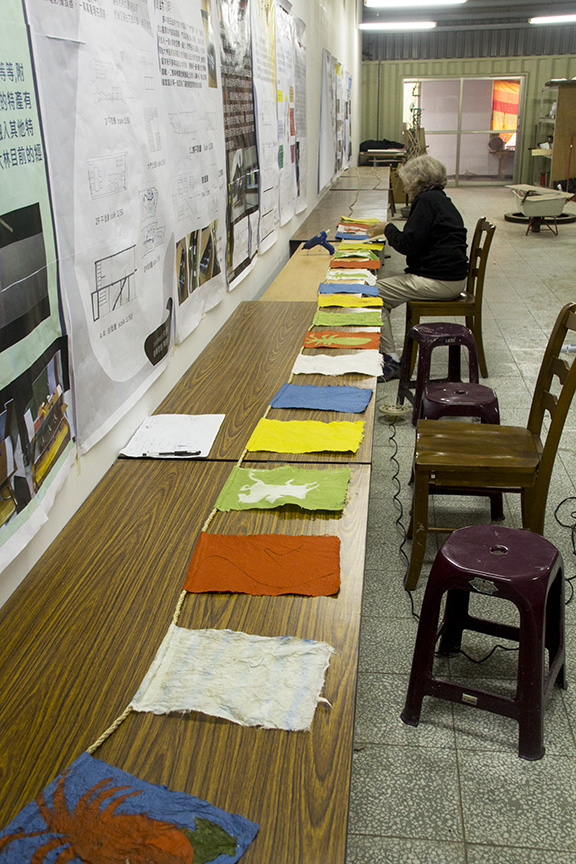
During the two-week residency, we made almost 300 handmade paper prayer flags in the traditional 5 colors. Blue means the sky, white means the clouds, red means fire, green means water and yellow means earth. With these five colors in their proper order, the prayer flags will help bring the world into balance. We put images of the “wind horse” on some of the prayer flags.  ImageHere a student is holding up the handmade paper with the wind horse image that he just made.  This image is often found on Tibetan prayer flags to carry the prayers with speed and strength to all the earth.  We also used images of the pineapple on some of the prayer flags because in Chinese culture the pineapple is a symbol for success and prosperity. We put many other good symbols and words in English and Chinese on the prayer flags and did some drawing and painting on the handmade paper prayer flags.  The tradition of hanging prayer flags is common in Tibet, and they are usually hung from high mountain passes to bring blessings and good luck to the people and all creatures.  I have also seen colorful prayer flags hanging at temples in Nepal, shrines in Japan and in other countries.  It is a great tradition and way of sending prayers or wishes in any language or culture.


The first part of the project “healing of the earth” was done on Tuesday of the first week I was there, and we consulted with a famous Feng Shui Master in Dalin who told us to connect the two sides of the ridge with threads in the 5 colors and to leave the threads across the road on the ground covered by some earth so that cars could still go across.  We also planted a young tree (a special Chinese banyan tree) on each side and tied the five colors of thread to the roots of the tree that was planted on each side of the road.  This symbolic joining back together of the broken land with the threads will start to heal this earth. 5 color thread joining finished


The second part of the healing will be my art installation made with the students consisting of 250 colorful prayer flags suspended on natural ropes from tall trees growing on each side of the road. There are 10 ropes each about 30 meters (100+ feet) , 5 on each side, with 25 prayer flags on each rope.Jane with long line of prayer flags We hope this art installation will help to complete the healing and bring good fortune and good luck to all the people and creatures of Nan Hua University.  The art installation will stay in place until it biodegrades and can go back to nature without harming the earth because all the materials are natural and biodegradable. Maybe it will last for several weeks or months; nature controls its destiny. I enjoyed very much the opportunity to work at Nan Hua University and create this art installation with the students and hope that it will help to “heal” a small part of earth on this campus and that it will inspire the students to take better care of our environment and to use natural materials and good environmental practices to make their art.   Really today the earth in all parts of the world needs healing, and all people should think more about what we do to harm the environment with our art and with our actions.

View of break in earth This photo shows the site for the art installation.  My next post will feature photos showing the finished installation of 250 handmade paper prayer flags.


Like Loading...

Sitka Center for Art & Ecology Artist-in-Residency, Oct. 2013 – Jan. 2014

11 Monday Nov 2013

Posted by janeingramallen in Uncategorized

≈ 1 Comment

Tags

artist-in-residency, handmade paper, Otis OR, Sitka Center for Art & Ecology, timothy s. allen

Image

I was awarded an artist-in-residence at Sitka Center for Art & Ecology in Otis, Oregon, from October 16, 2013 to January 10, 2014.  The Sitka Center is located in the northwestern part of Oregon on the coast just above Lincoln City.  It is a beautiful area, and Sitka Center is part of the Cascade Head National Scenic Research Area.  They have wonderful studios and small cabins for the residents here.  We are living amidst tall Sitka Spruce trees and also able to see the ocean where the Salmon River runs into the sea.  There are many elk here we are told – haven’t seen one up close yet but I have seen a big herd of elk far up on the mountainside. 

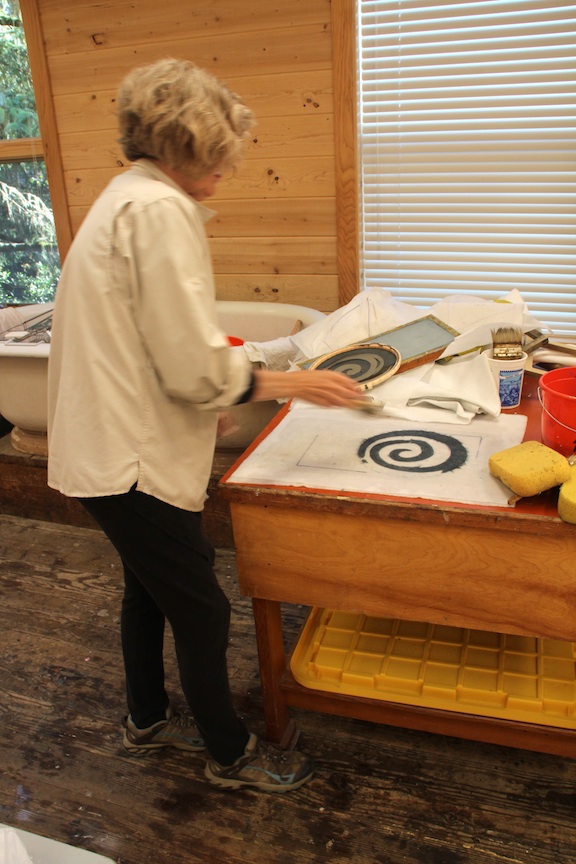
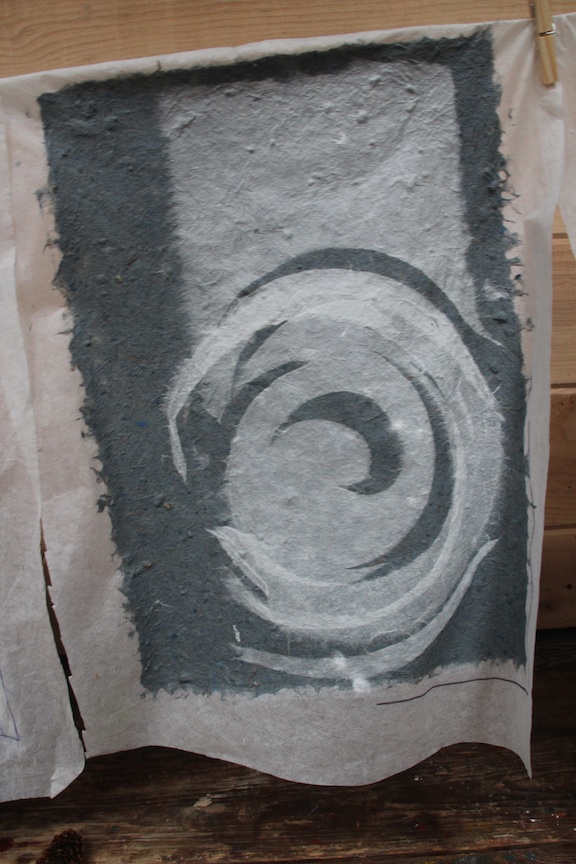
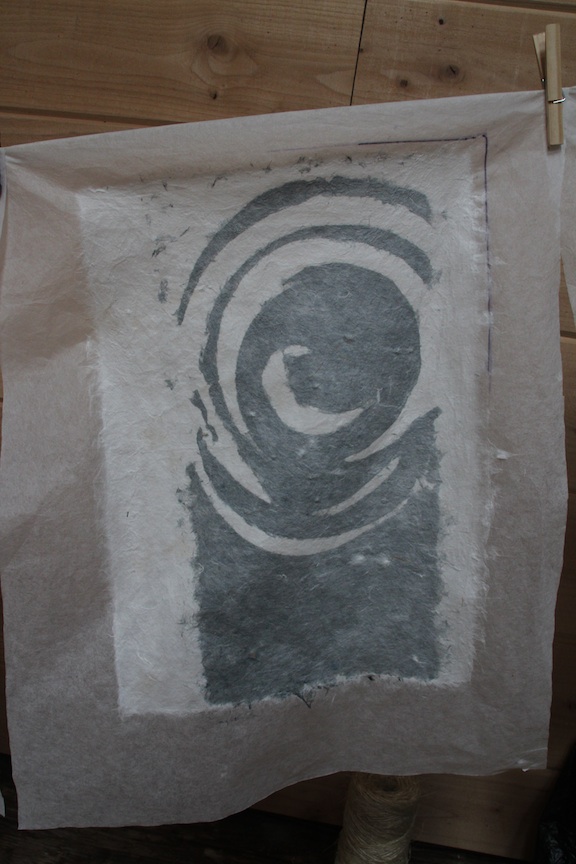
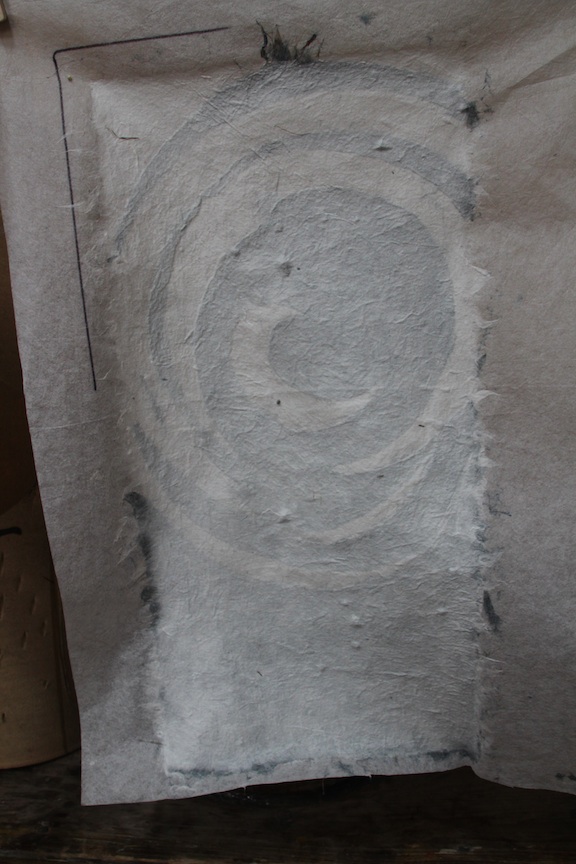
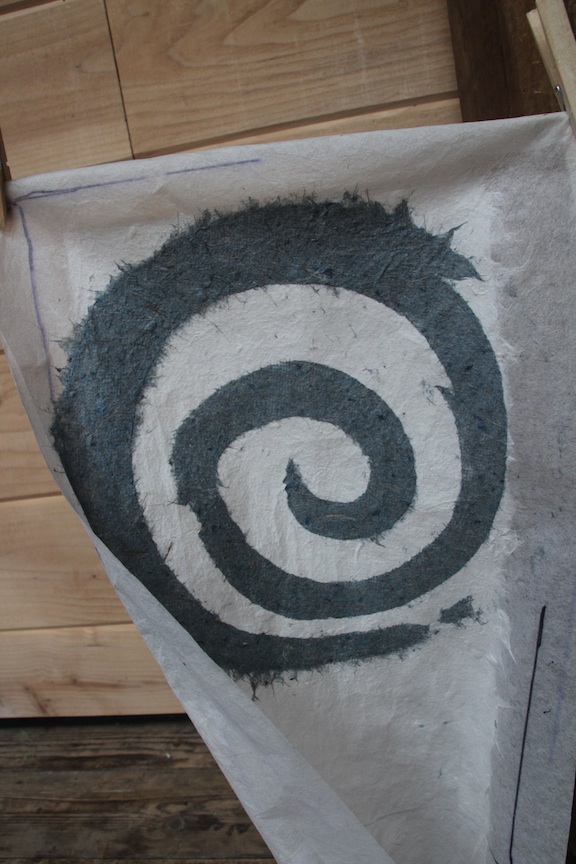
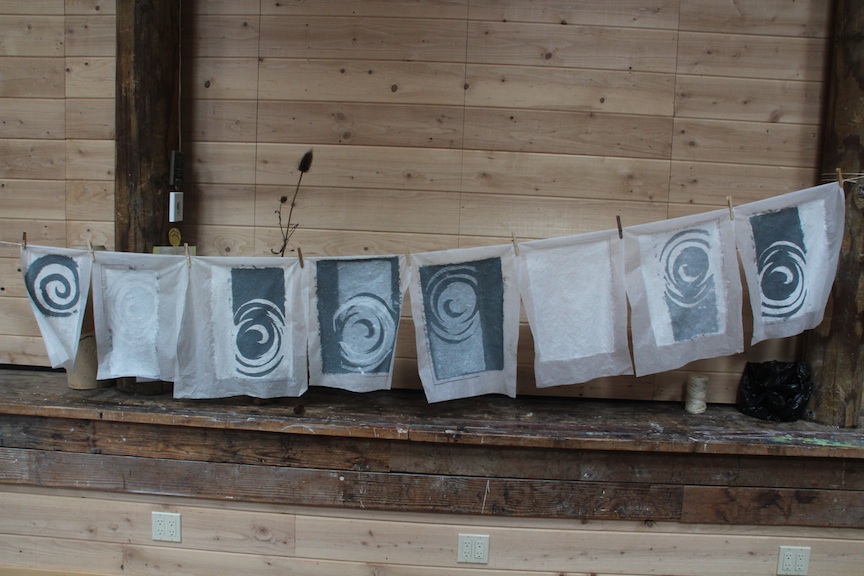
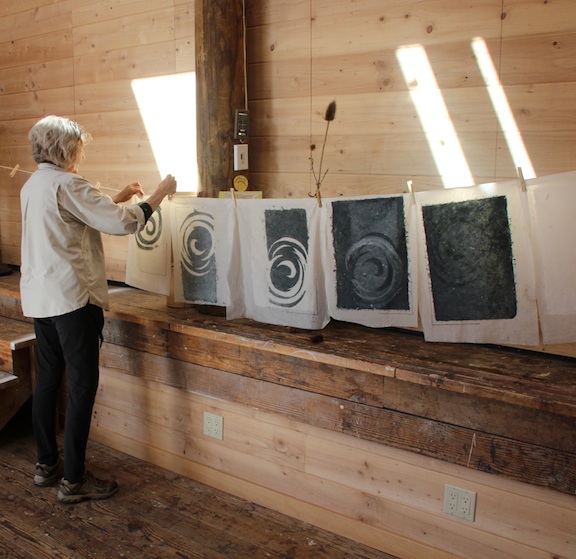
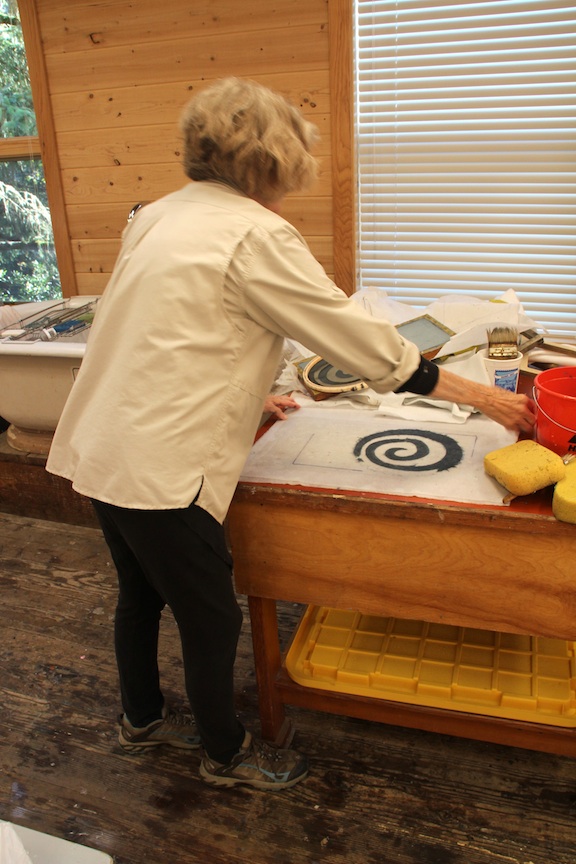
I am having a great time making my handmade paper art in the big and light-filled Boyden Studio at Sitka Center.  This studio has great facilities for a papermaking with a huge bathtub sink, stove and lots of tables and also a high ceiling for my suspended installations.  One of the things I started when I first arrived here was making paper with some pulp I brought with me, kozo and blue jean pulp.  I noticed the Sitka logo form that is on all the signs around here.  So, I decided to make some handmade paper that was inspired by the Sitka logo, a spiral form, that reminds me of the ocean, the wind and waves.  A poet Tom Crawford, also a resident artist here now, and I may collaborate with a calligrapher to put one of his Sitka inspired poems on some of my handmade paper.

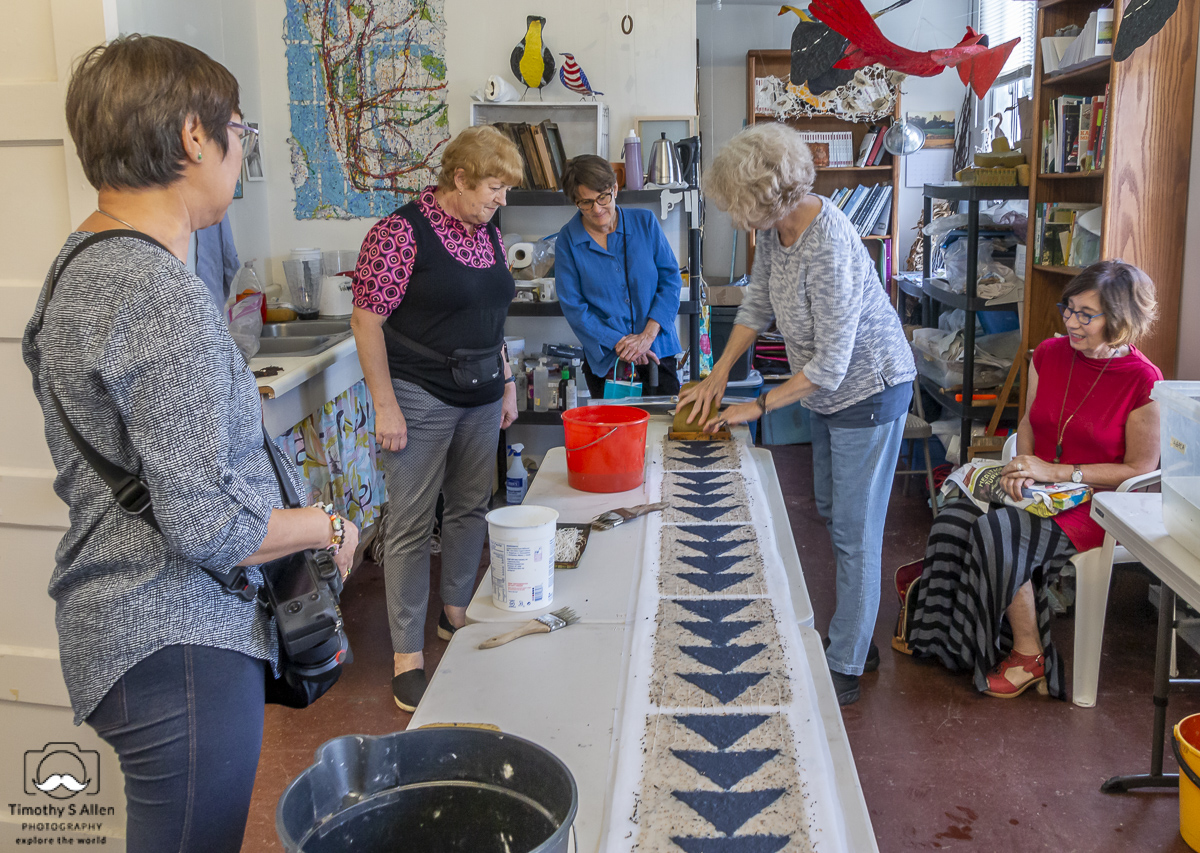
Here are some photos of me working in the Sitka Center studio and making the Sitka Center symbol-inspired handmade paper.  I am drying the paper on sheets of non-woven interfacing, and I used buttercut to make the spiral stencil on a round embroidery hoop frame with ordinary fiberglass window screening on it.

ImageImageImageImageImageImageImage

I am also making paper from plant materials collected here for a Sitka site map and other works I am planning.  I have made paper from 3 plants so far and have 3 others gathered and ready to cook up and make pulp.  I will keep posting here with news about the results from the Sitka plants and the new artworks I am making.

My husband Tim is here with me at the Sitka residency and he is enjoying taking photos of everything.  For some really great photographs of the Sitka area and the Oregon coast (also some of my art projects!), take a look at my husband Timothy S. Allen’s photo blog at http://allentimphotos2.wordpress.com

Like Loading...

Subscribe

  • Entries (RSS)
  • Comments (RSS)

Archives

  • April 2026
  • January 2026
  • December 2025
  • November 2025
  • September 2025
  • August 2025
  • June 2025
  • April 2025
  • March 2025
  • February 2025
  • January 2025
  • November 2024
  • September 2024
  • July 2024
  • May 2024
  • February 2024
  • December 2023
  • November 2023
  • October 2023
  • August 2023
  • July 2023
  • May 2023
  • April 2023
  • March 2023
  • February 2023
  • January 2023
  • December 2022
  • November 2022
  • October 2022
  • August 2022
  • June 2022
  • May 2022
  • March 2022
  • February 2022
  • January 2022
  • December 2021
  • November 2021
  • October 2021
  • September 2021
  • July 2021
  • June 2021
  • May 2021
  • April 2021
  • March 2021
  • February 2021
  • January 2021
  • December 2020
  • November 2020
  • October 2020
  • September 2020
  • August 2020
  • July 2020
  • June 2020
  • May 2020
  • April 2020
  • March 2020
  • February 2020
  • January 2020
  • November 2019
  • September 2019
  • August 2019
  • June 2019
  • May 2019
  • April 2019
  • March 2019
  • February 2019
  • January 2019
  • December 2018
  • November 2018
  • October 2018
  • August 2018
  • July 2018
  • June 2018
  • May 2018
  • April 2018
  • March 2018
  • February 2018
  • January 2018
  • December 2017
  • November 2017
  • October 2017
  • September 2017
  • August 2017
  • July 2017
  • June 2017
  • May 2017
  • April 2017
  • February 2017
  • January 2017
  • December 2016
  • November 2016
  • October 2016
  • September 2016
  • August 2016
  • July 2016
  • June 2016
  • May 2016
  • March 2016
  • February 2016
  • January 2016
  • December 2015
  • November 2015
  • October 2015
  • September 2015
  • August 2015
  • July 2015
  • June 2015
  • May 2015
  • April 2015
  • March 2015
  • February 2015
  • January 2015
  • December 2014
  • November 2014
  • September 2014
  • July 2014
  • June 2014
  • April 2014
  • March 2014
  • January 2014
  • December 2013
  • November 2013
  • October 2013

Categories

  • Costa Rica Residency 2023
  • For the Birds
  • Uncategorized

Meta

  • Create account
  • Log in

Blog at WordPress.com.

  • Subscribe Subscribed
    • Jane Ingram Allen Art Projects
    • Join 100 other subscribers
    • Already have a WordPress.com account? Log in now.
    • Jane Ingram Allen Art Projects
    • Subscribe Subscribed
    • Sign up
    • Log in
    • Report this content
    • View site in Reader
    • Manage subscriptions
    • Collapse this bar
 

Loading Comments...
 

    %d